Sunday, January 5, 2014

De Vuelta a Casa

{This post contains affiliate links.  Thanks for supporting my blog.}

I love Oliver Jeffers' stories and read them to my students often. De vuelta a casa is no exception.  This cute story is about a little boy who gets stuck on the moon with a martian. They figure out how to fix their ships and eventually are able to return home. Their method of escape from the moon is humorous and downright cute.  With this book you can introduce some of the main vocabulary by making card to play Go Fish or Memory.  See here for an example from one of Jeffers' other books.

Vocabulary


el avión
despegar
el cielo
la luna
la linterna
las baterías
aterrizar
el marciano
volver
la Tierra
el mar

To see my other reviews of Jeffers' books in Spanish click on the category "Oliver Jeffers" in the sidebar.  More reviews to come...

Wednesday, January 1, 2014

El Misterioso Caso del Oso

{This post contains affiliate links.  Thanks for supporting this blog.}

El misterioso caso del oso is another great book by Oliver Jeffers that can be used to increase vocabulary for your Spanish students.  In this story, the woodland animals are trying to figure out the mystery of where all the trees are going. The mystery is eventually solved when the bear is caught chopping down trees to make paper in order to enter a paper airplane contest.

There are several sets of vocabulary that can be introduced with this book, but the most unique list would be words related to mysteries or court cases...

las pistas-clues
el testigo-witness
las huellas-footprints
el culpable-the guilty one
interrogar-to interrogate
el juez-judge

Or you could introduce the names of the animals in the book...

el oso
el búho-owl
castor-beaver
el cerdo-pig
el ganso-goose
el ciervo-deer
el koala

Such a cute book!  Be sure to check out my other reviews of Oliver Jeffers books in Spanish.  I will be posting more of them through the month of January.  To find them either click on the link {that says Oliver Jeffers} at the beginning of this post or click on "Oliver Jeffers" in the categories on the sidebar.

Tuesday, December 17, 2013

Ten Ways to Use Picture Dictionaries in a Language Classroom

{Affiliate links used.  Thank you for supporting this blog.}

Picture dictionaries are a great jumping off point for conversations in the target language you are teaching.  I love using the types of dictionaries that have "scenes" that you can use to talk about many different topics.  The dictionaries I have listed here are {at the time of this posting} out of print {at least the Spanish versions are...other languages are available}, but they are readily available on the used market through Amazon and other sites.

Picture dictionaries with scenes can be used in a variety of ways.  Here is a list of ideas:

{NOTE: All of these activities are done in the target language...on both the teacher and student side.}

1. Ask where certain items are in the target language and the student points them out.

2. Counting items on the page.

3. Show them a scene and they have to describe it in the target language.

4.  Practice prepositions by describing where things are located.  I normally do this by giving the student(s) two items in Spanish.  They then have to tell me how the first item is positioned in regards to the second item.  For example:  El gato esta encima de la mesa.

5. Call out an item and the students give you an adjective for it.

6. Have the students describe the actions going on in the scene.

7. Discuss the emotions of the people in the scene.

8. For pages with lots of food pictures on them call out a color and the students tell you the foods that are that color.

9. Also, for food pages, call out an adjective like sweet or salty and have students list foods that fit that description.

10. Call out a letter of the alphabet and see if students can list any items on the page that start with that letter.


Let's Learn Spanish-Picture Dictionary-I love this dictionary particularly for its opposite page {see above}.  With this page I ask questions like, "Where is the fast mouse?"  "the tall mouse?", etc.


First Thousand Words in Spanish-This dictionary is the one I have used the longest in my teaching.  Scenes in the middle with vocabulary around the sides.


Everyday Words in Spanish-Most of my younger students love this book with claymation type characters. Once again there are scenes with vocabulary on the sides.

You can probably find another million ways to use these books.  I would love to hear your ideas!

Wednesday, December 11, 2013

Christmas Vocabulary Games


{Affiliate links used. Thanks for supporting this blog!}

Here is a quick game to make to teach/review some of the words related to Christmas and winter.  I use these pictures to make cards by printing them and cutting them out and taping them to half index cards.  By printing out one set you have enough cards to play memory, but if you make two copies of the file...Christmas vocabulary cards you can do Go Fish with sets of four cards for each vocab word.

For memory I have the students say the word in Spanish for each card they pick up.  For Go Fish you use the vocabulary to play the game by asking "Tienes el regalo" or whatever picture you are looking for.  To say "Go Fish" I use "Pesca" with my students.

Here is the list of the words used for these cards:


El árbol de Navidad

La nieve

El muñeco de nieve

Las luces

La vela

El adorno

La estrella

El regalo

These games are super easy to set up and play.  The concept can go for any set of vocabulary.  It is just a matter of making the cards!

Saturday, December 7, 2013

Dice in Language Learning


{Affiliate links used.  Thank you for supporting this blog!}

I love making language learning into a game if possible. Even if the activity we are doing isn't really a game, dice give a hands-on experience to what we are practicing in the language.  There are several types of dice that I use when teaching.


Dice Within Dice are great for practicing sentence constructions, verb conjugations, and adjective/noun agreement.  On my whiteboard I will normally make two lists.

COLOR
1. Uds.
2. yo
3. Carla y yo
4. ella
5. tu
6. Ud.

BLANCO
1. decir la verdad
2. hacer la tarea
3. pedir la comida
4. encontrar un gato en la calle
5. salir con amigos
6. perder los libros

Students takes turns rolling their "Die within a Die" and creating a sentence.  For example, if a student rolled a "2" for the colored die and a "4" for the white die, the sentence she would need to come up with would be "Yo encuentro un gato en la calle."

One way to mix this activity up a bit is for the teacher to participate.  I roll the dice and then say the sentence, but I don't always do it correctly.  It is the students' job to figure out if the sentence is "correcto" or "incorrecto".

This method could be done with lots of types of sentences.  Here are some ideas:

-Subjects and adjectives {Ella es flaca.}  Great for practicing noun/adjective agreement.

-Subjects and items we know.  {Ella sabe bailar.   or  Yo conozco a la profesora.}  This is great for practicing the difference between saber and conocer.

-Subjects and adjectives-some that take ser and other estar.  {Nosotros estamos aburridos.   or  Uds. son altos.}

-Even more complex sentences can be done if you give the students three dice (or one die within a die and a single separate die).  For example...
Subjects-objects-recipients of the objects {Yo le doy la bici a Ricardo.}  Or use double object pronouns...{Yo se la doy.}

-Also with three dice:  Subject-preposition-place  {Yo estoy a la derecha de la silla.}

-With four dice or two dice within dice...
subject-verb that takes subjunctive-subject-second verb  {Yo quiero que Carlos haga la cama.}


Number Dice are great for practicing saying the numbers out of order.  It is great when a student can learn to count in Spanish or another language, but the true test is when they can see the number and tell you what it is.  Sure, students for awhile might have to "count up" to tell you the number, but the more they practice the easier it gets.  I use one to four of these dice and have them roll them all at once. Then they have to line them up and tell me what number they have. Great for older students needing to practice higher numbers.

Another option is to have a group of number dice on the table and then call out a number that the student then has to create with the dice.


Math Operation Dice along with regular dice can be used to do math problems in the target language.
Friday, November 22, 2013

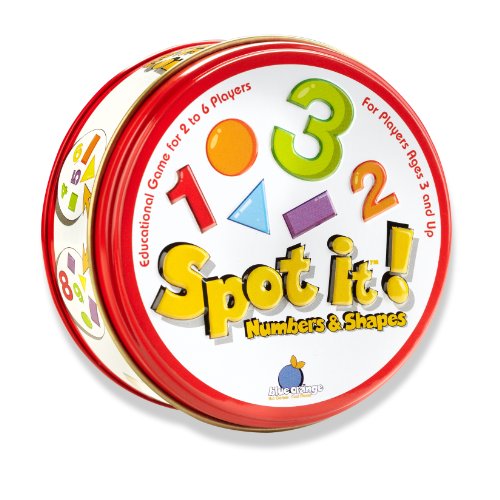
Spot It! Games for Learning another Language

I love using games that are already prepared for me in my Spanish lessons.  I recently came across Spot It!  I have been using it with my students and they are loving it.  At first, I feared it wouldn't work if my students didn't know all the vocabulary on the cards, but I have found that this isn't a problem.  The game actually teaches and reinforces learning!  It is also fast moving which brushes away any boredom your student(s) may have. Without fail, I have parents who watch me play this with their kids and then have to go out and buy it. It is that good!  This game would also be a great time filler in a classroom for students that finish early.

Here is how it works:

Each card has several pictures on it.  Any two cards in the deck have a matching picture.  The goal is to be the first one to call out the name of the picture. I have modify the rules a bit for my language learners.  If they spot the match, but can't remember the word they need to point to it.  I then supply them with the word.  It only takes a few times of supplying the word before they remember.  The more you play the more they learn.  Students are highly motivated because they want to be able to call out the word first!

There are several versions of this game...


Spot It! Numbers and Shapes

Spot It! Alphabet
Spot It (The original game)

Spot It Junior Animals (a favorite of my students)

There are also several other versions that have very specific vocabulary.  There is a baseball, hockey, Halloween, and road trip version. There is even a Spot It! Basic Spanish! Check them all out!

Monday, November 18, 2013

Arriba y Abajo


Anytime you read a book to a child it is an opportunity to teach.  Recently, I invested in several of Oliver Jeffers' books in Spanish.  They will become a springboard to teach and cement extra vocabulary.  Here is what I did with the book Arriba y abajo:

Arriba y Abajo is a sweet story about a penguin who wants to fly.  In the end, the flying adventures make him realize that he would rather be with his friend, the little boy in the book.

First of all, I picked out the words that I thought would be important to introduce to my students.  Here is my list which are mostly opposites along with a description of which picture each word is in the Go Fish cards below (scroll down to see link):

arriba-up (little guy pointing down)

abajo-down (little guy pointing up)

tocar and jugar- to play (Each has a different meaning.  Tocar is to play an instrument and jugar is to play a game. While the word "tocar" is not in the book there is a great illustration of each of these actions-see above)  (Tocar-a tuba and jugar-backgammon like in the story)

juntos-together (penguin baby and mom)

solo-alone (penguin baby by itself)

volar-to fly (little guy with green cape)

aterrizar-to land (helicopter landing)

las alas-wings  (pilot wings)
 

I created cards of the above vocabulary and we played Go Fish with them to solidify the meanings in their memory. 
I make sets of four to play Go Fish.  I also can use the deck for Memory if I pull out some of the cards as you only need sets of two for each word.

{Close up of one of the cards I made}

To make the cards I cut up the graphics from the below file and put them on 3 by 5 index cards cut in half or these bulletin board cards I found at JoAnn's.


Here is a link to the graphics for the cards:
Arriba y Abajo cards

I will be posting more about Oliver Jeffers' books and a few activities to go along with them in the near future.