Showing posts with label Family. Show all posts

Monday, April 17, 2017

Family Trees in Spanish


{Affiliate Links Used.}

I love using "garage sale dots" (You know... those little round stickers you see used every summer as people endeavor to sell their excess possessions. 😏) These dots have become valuable teaching tools when it comes to my language lessons! One of the ways I used them this past year is to create family trees with my students.


I had my students choose a different color for each generation. They then could create their families (or a pretend family) with each dot representing a different person. Then finally, they drew arrows between people and wrote in Spanish how they were related.


This simple exercise not only helped them retain the vocabulary, but also understand the relationships better. For example, they get to see how cousins are connected because their parents are siblings or how a person can be a sister, niece, cousin, and daughter all at the same time. Such a simple exercise that only takes dot stickers, a blank piece of paper, and a pen or pencil! Give it a try with your students the next time you work with family vocabulary! (NOTE: For younger kids, it is helpful to first show them examples of family trees with pictures of people and then create the one with dots.)

Here are a few more resources while working with family member vocabulary:


This file folder guessing game uses house and family vocabulary.


A sweet story about a boy who gives away his animal crackers to different family members.

Here's another activity with colored dots that my students love!!! Check it out!

Monday, February 13, 2017

How Parents Can Help with Language Learning


{Affiliate links used.}


Being bilingual is a valuable skill for our kids. It gives them an understanding of the world around them, improves their knowledge of their native tongue, and makes them more of an asset in the workforce in the future. I have taught Spanish for over twenty years and have found that parents play a key role in language acquisition for their kids whether it is a first or second language. Parents can add a second language into daily family life to encourage learning. Many times parents are at a loss on how to do this. The task seems overwhelming. So here are some ways you can promote a second language in your home. There are activities for all language level abilities of parents and for all ages of kids.

Common Commands- Using simple everyday commands when appropriate can build a child's vocabulary. Whether a child is getting dressed, helping in the kitchen, or getting ready to leave the house parents can add a few simple commands to their routines in the target language.

Here is a set of commands in Spanish.
And another list in Spanish

Or how about your child giving commands to a pet?  Here are some simple commands for dogs in Spanish...The graphic is pretty small, but if you copy it, enlarge, and then print it, it should work.

Spanish Dog Commands

Reading Books-If your kids are young enough and you feel reasonably confident in reading to them in the target language, there are tons of books out there for kids in other languages. Reading stories to kids helps improve their vocabulary and allows them more opportunities to hear the flow of the language. If you are uncomfortable reading the target language, check online resources where the stories are already read aloud for you.

31 Spanish Books for Kids
Learning Through Spanish Books for Kids
Spanish Children's Books Online
French Children's Books
Italian Children's Books
German Children's Books


Games and Fun- Games are a great way to add some fun to language learning. It's my sneaking way of getting kids to learn without them realizing it. Here are some games that work well in a family environment...

Bananagrams and More...-I love pulling out Bananagrams and playing "Beat the Teacher" with my students, but you can play "Beat the Parents". Basically, you set a timer for a couple of minutes and with all the tiles face up your child(ren) try to create more words in the target language than you can. Sometimes it helps to have a list of vocabulary words to work off of (like clothing or body parts).
Spanish Bananagrams
French Bananagrams
German Bananagrams

KLOO- This game, which comes in Spanish, French, or Italian, is great for older kids or high schoolers. Your kids should have a basic understanding of the sound system so they can read the cards outloud. Also, some basic vocabulary under their belt helps, too. These games are awesome as they are self-teaching...everyone learns vocabulary the more you play! You can check out these games here.

Post it-If your children are at the age where they can read then using Sticky Notes to label the things in your house in the target language may be a fun way to increase their exposure to vocabulary. You can label furniture, rooms, even the food in your fridge or cupboards! Sure it might look a little strange when company comes over, but it sure will be a topic of conversation. When the stickies are up you can call out items and see if your child can find them in the house. Also, just the fact that they are seeing the words day in and day out will help them internalize them.

Picture Dictionaries-Language picture dictionaries have lots of opportunity for language learning. Here is a post with tons of ideas on how to use them with kids.

Hang up the Humor-I put up comics for my students to see in Spanish. They normally are motivated to figure out the punch line or source of humor even though it is in another language. If you are doing Spanish in your home, here is my Pinterest board with tons of easy humor for language learners. Having some of these up around the house and changing them from time to time adds to more learning.

Finally, I found this graphic from Spanish Playground with helpful ideas to support your child as he/she learns the language.

Thursday, November 10, 2016

Spanish File Folder Guessing Game

{Affiliate links used.}

A few years back, I found an old game at a garage sale in which you have to guess where the family members are located in your opponent's house. It is a GREAT game for talking about the rooms in the house, using the verb "estar", and discussing family members. However, I only had one game for two players so I never could use the game in groups. So I decided to make my own! While this project is a lot of prep, the work is worth it as your students will spend about 10-20 minutes completely in the target language, and the games can be used over and over again. So let's take a look at how the game is played...

{See the photos as a reference.}
Each person has a game board/folder with two houses on it. One house is where the player arranges family members in certain rooms. The other house is for recording where the family members are in his or her opponent's house. To set up, each player places all eight family members (grandpa, grandma, dad, mom, brother, sister, dog, and cat) in one of the houses. They lay the other set of family members off to the side. Then the players take turns asking yes/no questions about each other's houses like...

Is the dad upstairs?
Is the dog downstairs?
Is the mom in the bathroom?

They keep going back and forth with questions until all of the second set of family members are placed correctly in the second house. The first player to figure out where every family member is in his/her opponent's house wins.

To play the game, each person needs a playing board that has two pictures of the same house, two sets of family members, and I also include a card that helps my students with vocabulary and forming the questions (photo #6).

In order to make the boards you will need the following items to make this game:
To assemble the boards:
  • Print out the houses (two houses per game folder). Make sure you print a size that will fit in a file folder after it is laminated. Laminate them.
  • Print out the family members (two families per game folder) and laminate them. Make sure that the family members are printed out to a size in which they can fit in the rooms of the house.
  • Adhere two houses onto the inside of a folder (See the picture below). I used glue dots or you could use liquid glue. Make sure you DON'T center the houses but rather put them off to the side so that you can put the envelope of playing pieces (photo #5) and the vocabulary list (Here's the list) (photo #6) in the folder.
  • Use glue dots to adhere the envelope to one of the sides of the file folder.
  • Print out a vocabulary list and/or a list of possible questions to use during the game. Laminate it and put it on the other side of the folder. 
  • Adhere the clear part of the Velcro dots to the rooms in the house with the E-6000 glue. I put only one or two dots in each room. You want as many dots in the house as family members. I used 8 people (grandpa, grandma, dad, mom, brother, sister, dog, cat). You can kind of see the dots in photo #4.
  • Adhere the white side of a Velcro dot to each family member using the E-6000 glue. 
  • Let dry.
  • Play the game!
NOTE: The Velcro dots already have an adhesive on them, but I used the E-6000 glue to make the game extra durable.

I have my students use the top house to place their family members while the bottom house is where they place the people once they figure out where they are located on their opponent's board. The file folder makes an excellent "shield" so that the opponent can't see where the family members are placed.

I have a feeling that the possibilities could be expanded for this type of speaking game. For example, you could have pictures of an empty fridge and have students converse until the fridge is full with the correct foods. Or you could have a simple street map in which students have to guess where the different buildings are in their partners' city. Another idea is to have faces in the file folders and players have to guess what the face of their opponent looks like (hair and eye color, hair length, facial hair, etc.). So many ideas you could use to help your students work with the vocabulary they are learning!


Tuesday, April 19, 2016

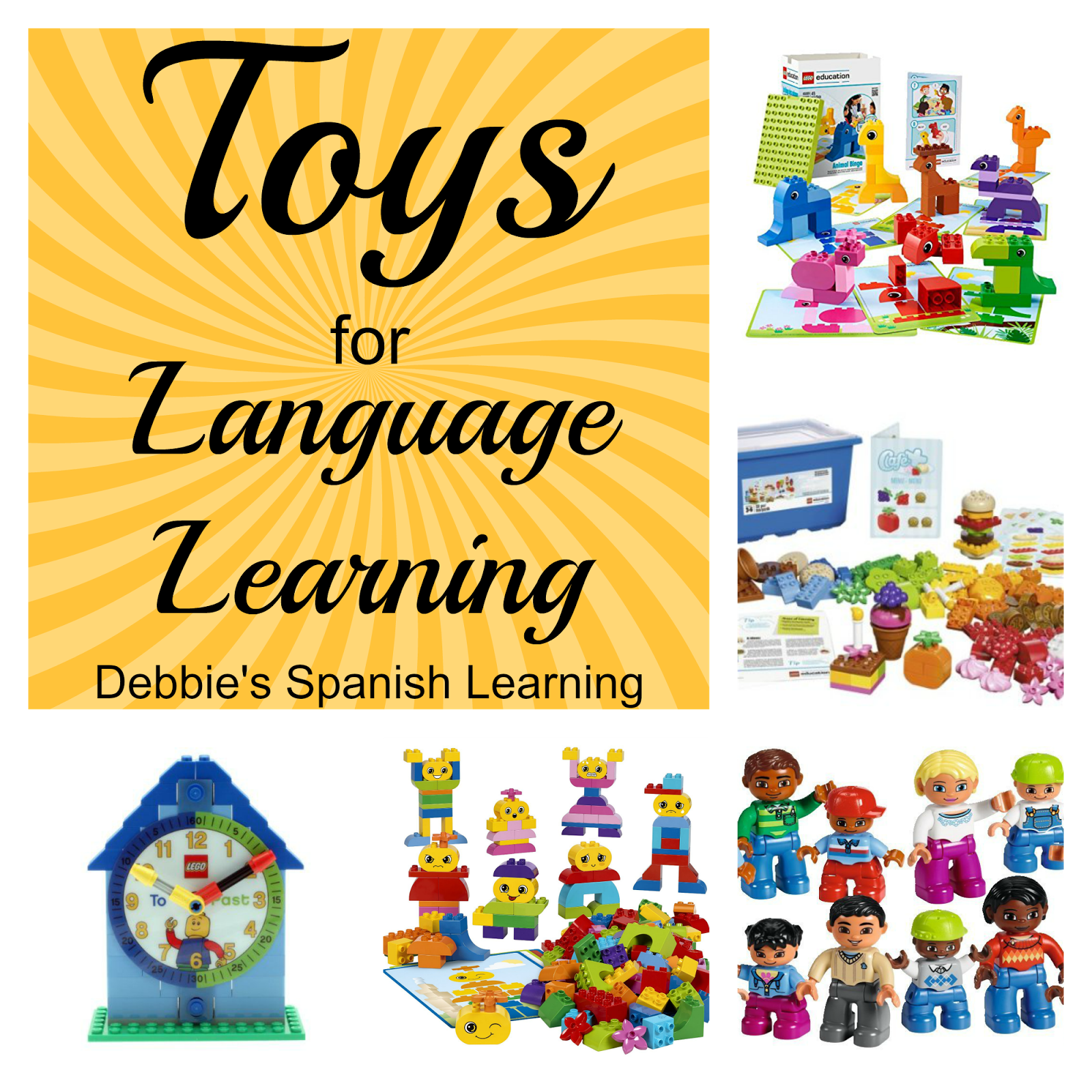
Toys for Language Learning


Affiliate Links used.

For young kids (and even some older ones), there is incredible value in having items that they can manipulate as they learn. My students eyes light up when I bring out any type of item that is toy-like to help them acquire Spanish. That's why this list of building sets could be incredibly valuable when you are teaching another language to kids.

These LEGO® sets would work really well if you are teaching young kids a foreign language...

The first one that caught my eye was the Build Me Emotions set. For years I have struggled to come up with ideas for teaching emotions so I am always on the lookout for new ideas. I see so much potential for this set like...

  • Telling students "Edifica triste" or "Edifica contento" then having kids build a character with that emotion.
  • Calling out an action in the target language and having them make a person with an appropriate emotion on its face. For example, the teacher says "Yo como el chocolate" and a happy person is built.
  • Describing a person (what they are wearing) and what they are doing then having kids make that person with the correct colored clothing and a facial expression for the action.


The Animal Bingo set is a like a bingo game in which kids pick a building card that allows them to create an animal as they collect the pieces for it. With this game, there is the opportunity to learn animal names, colors, and shapes.


The World People Set are great props for physical description of people and clothing. The vocabulary for family members would work well with these also. I would use this set by displaying all the figures and then describing in Spanish one of the people to see if my students can guess who I am talking about. Students can also describe the people in the target language. Another idea is to categorize the people into groups by calling out a characteristic like "pelo moreno" or "lleva azul" and have your students separate out those that fit into that category.


Community Minifigures - a great set for discussing occupations and descriptions of people.


Time Teacher with Constructible Clock- A clock that kids can build and that you can use with them to teach them to tell time!


Family and House Kit- Build this house and then there are opportunities to talk about the rooms of the house and what they contain. This set would be great to work with prepositions. Students could describe where things are located in the target language or the teacher could tell students where to put certain items.


This Food Set has a plethora of pieces so that kids can "build" different foods. This is definitely on my wish list as I know my younger students would adore it! There are opportunities to discuss the colors of the foods, learn new food words, and even do categories of foods (like fruits, veggies, meats, etc.)

LEGO®is a trademark of the LEGO Group of companies which does not sponsor, authorize or endorse this site.


Saturday, January 24, 2015

La Casa Adormecida


This post is part of a series, 31 Days of Spanish Books for Kids. Please click HERE for the complete list of posts. {Each of these posts contain affiliate links. Thanks for supporting this blog!}


I love using children's literature that has repeating phrases when teaching my Spanish students. It gives them a chance to hear a word or combination of words over and over which aids in them learning more vocabulary. La Casa Adormecida provides a tremendous amount of repetition in each page. The premise of the plot is a house full of nappers that pile onto one bed. With each page, the list of sleepers is repeated with another character added.

Here is the list of characters that decide to take a nap and are disturbed by the final arrival (the flea):

La abuela
El niño
El perro
El gato
El ratĂłn

La pulga

La Casa Adormecida is an excellent teaching book for language learners. One of the concepts you can focus on are prepositions like...

sobre
encima de
debajo de

The word "sobre" is the one used in the book, but I have downloaded, colored, and laminated the characters from the book so that we can practice these prepositions. In Spanish I give my students instructions on how to arrange the characters on the bed.  Here are some examples:

"Pongan la abuela sobre el gato."
"Pongan la pulga sobre el perro."

You don't necessarily have to put them in the order the book does.  Actually, there is humor in putting them in an order that doesn't make sense like putting the grandma on top of everyone else. After arranging them in the bed I can then ask my students questions about the characters' location. Who is under the flea? Who is on top of the boy?


Another activity that can be done is math related. I teach my students the words for "feet" and "paw" (el pie y la pata). We then proceed to count the number of feet or paws in the house. I give my students footprint stickers and paw print stickers. We then go through the process of counting out how many feet and paws to put on a piece of paper to correspond with the number in the book.  A great way to review numbers!

La Casa Adormecida is definitely not to be missed! My students have loved this book and the activities that I do with them.

Wednesday, January 14, 2015

Yo TenĂ­a un HipopĂłtamo


This post is part of a series, 31 Days of Spanish Books for Kids. Please click HERE for the complete list of posts. {Each of these posts contain affiliate links. Thanks for supporting this blog!}


There aren't a lot of Spanish children's books out there that deal with family names (padre, madre, abuelo, hermana, prima, etc.), but Yo TenĂ­a Un HipopĂłtamo does an excellent job of introducing the basic family relationships.

The book opens up with a young boy eating animal crackers, but the crackers in his mind become real. He then decides to give away various animals to different family members and friends.


The illustrations are colorful and humorous. The language is simple and repetitive enough for beginning students to understand the gist of the story. It is also a great book for those students just learning to read!


Using Yo TenĂ­a Un HipopĂłtamo you can talk about family members, animals, and practice the construction "Se lo (la) di" (I gave it to him/her). 


Wednesday, October 30, 2013

Oso Books for Vocabulary Building

{Affiliate links used.}

The Oso books by "Barefoot en Espanol" are awesome for vocabulary building!  These simple books work well with younger kids to introduce them to a variety of topics like days of the week, places, profession,etc. Here is a list of the books available and the topics they cover.


Bear in Sunshine/Oso Bajo El Sol  (Weather, Seasons, Favorite Activities)
Oso en la Ciudad (Places, Days of the Week)
Oso En Bicicleta (Places, Transportation)
Oso En Un Cuadrado (Shapes, Colors, Counting)
Oso en el Trabajo (Professions, Places)
Bear at Home/Oso En Casa (Rooms and Items in a House)
Bear's Busy Family/ La familia ocupada de Oso (Family, The Five Senses)

Many of the books at the end have a picture review of the vocabulary and/or a list of key words.  Like for example in Oso en Casa there is a floor plan of the house.


Or a review of shapes and colors in Oso en el Cuadrado...


Great little books for language learning!

Thursday, October 3, 2013

Learning Spanish with Children's Books


Using children's books to teach kids Spanish is a wonderful way to build vocabulary and introduce sentence structure in a natural way.  Over the years I have collected tons of books in Spanish to augment my teaching.  Last year I taught a Spanish Circle (lessons that include songs, rhymes, books and activities to model the language) in which I teach different themes to elementary kids.

Below you will find a list of books that I use for the different themes that I teach.  Stars are put beside the books that are not to be missed!  I have chosen books for several reasons.  Some are great because of the wealth of vocabulary they offer for that theme.  Others are good because they are classics that are related to the theme or because kids love the humor or storyline in them.  Some are out of print, but can be bought at other places or used on Amazon.  So take a look...


{Affiliate links used. Thanks for supporting this blog.}

Numbers
**Elefante Tiene Hipo Unfortunately, this books is currently out of print.  It is a great one to review numbers (numbers 1 to 10 are counted backwards in the story) and animal names.  The humor is awesome in this book!
-Mi Abuela Va Al Mercado
 **Demasiados globos I have used this book for many years to teach colors, numbers and introduce animals.
**Llaman a La Puerta-I love this book, because it teaches the concept of dividing groups evenly. I actually use plates and laminated cookies for students to use as we go through the book. See this post for more information.
**Un Alce, Veinte Ratones-This is a great book to review numbers 1-20. Read about how I use this book here.
-Los Cinco Patitos-A cute book that counts down from five to one. Great plot for the younger set that makes them curious as to how the story will end.


Colors
**Demasiados Globos (See link and description above in Numbers)
-Pinta ratones  Helps with the concept of mixing colors
 **Sali de paseo  Simple language.  Color and animal vocabulary
 -Oso pardo, oso pardo, ¿quĂ© ves ahĂ­?
 -Huevos verdes con jamĂłn  Not a lot of color words here, but a fun classic to read with lots of other vocabulary
**Colores-This book is super cool, because it has clear pages that change the colors of  the page behind them. You can see how it works by clicking here. (NOTE: This shows the English version of the book just to give you an idea on how it works. Click on the word "Colores" above to find a link to purchase the Spanish version.) I have my students "read" the book back to me by saying the colors as I move the pages.


Body Parts
**Fuera de aquĂ­, Horrible Monstruo Verde-Great book to use for teaching the parts of a face!
**Un Bicho Extraño-This book goes through several different body parts, and is a "never-ending" book in that you read it one way and then turn it upside down and continue reading.
 -Soy Demasiado Grande
-Se Venden Gorras  A great classic
-Froggy Sale a Cenar  I love the humor in the Froggy books.  These books are more suitable for older elementary kids.
 -Froggy va al medico
**De la cabeza a los pies-Lots of body parts mentioned in this fun book in which your students can do the movements.

Opposites
-Soy Demasiado Grande  (See link above in Body Parts)
-Perro grande... Perro pequeño
-Un Cuento De Un Pez Grande
**Cerdota Grandota -Cute book with lots of opposites.
**Contrarios-Another book with transparent pages that teaches opposites.


House
**Ruidos en la casa: Un misterio cĂłmico I love this story of a scared little puppy alone at home.
 -Migas en las escaleras
 -Oso En Casa
 -La casa adormecida   A great classic!
 -Vamos Froggy


Family
-La Semilla de Zanahoria
 -Abuelita Fue al Mercado  (See link above in Numbers)
-La Hermanita De Froggy
 -¿Tu mamĂĄ es una llama? A classic that has been translated well with the rhyming
 **Si Yo Tuviera Un Dragon A little boy wishes for a dragon instead of a little brother but in the end realizes that a brother might be better!
 **Yo Tenia Un Hipopotamo Lots of family vocabulary


Time/Good night/Good Morning
**Chumba la Cachumba Great traditional rhyme/song that teaches the hours of a clock.  Very humorous illustrations showing what a group of skeletons do at each hour.
-Buenas noches a todos
 -Los Durmientes de Lola Fuentes
 -La casa adormecida (see link above in House)
-Froggy Se va A Dormir
 **Froggy Duerme Fuera de Casa
 -Buenas Noches Luna
**Llevé a la Luna a Pasear


Where is it?/Prepositions
-¡Corre, perro, corre!
 -Migas en las escaleras (See link above in House)
-Se Venden Gorras  (see link above in Body Parts)
-Donde esta la oveja verde?
 -Lupe Lupita, ¿dĂłnde estĂĄs?
 -Vamos Froggy (See link above in House)
-Arriba Y Abajo-This books also teaches the five senses.  Available at Sonrisas Spanish School 
**Arriba, Abajo, y Alrededor-This book teaches the prepositions that are in its title, plus it is a great introduction to food words.
-El Pastel EstĂĄ Tan Arriba-teaches arriba and abajo.


Clothing
**Froggy se viste  Another great Froggy book.  This is the only one currently in print.  The others mentioned here can be bought used.  Lots of great humor.
 **Azul el sombrero, verde el sombrero Great humor and lots of repetition of clothes and colors.
 **Los animales no se visten /Animals Should Definitely Not Wear Clothing Absolutely hilarious!
-Se Venden Gorras  (see link above in Body Parts)
-Vamos Froggy (See link above in House)


Seasons/Weather
**Un recorrido por las estaciones Beautiful illustrations.  Also teaches the months.
-Oso Bajo El Sol
 **Un Dia de Nieve-Love this classic!
-Un DĂ­a de Lluvia
-Froggy se viste (See link above in Clothing) Lots of words surrounding winter


Days of the Week
-La oruga muy hambrienta
-Oso en la Ciudad

Places in a City
-Oso en la Ciudad (see above link)
-Taking a Walk/ Caminando: A Book in Two Languages/ Un Libro en Dos Lenguas

 Food 
**La oruga muy hambrienta-Lots of foods in this book plus days of the week!
**Quiero Mas Fideos!
 -A Comer!
 -Froggy Sale a Cenar (See link above in Body Parts)
-Arriba, Abajo, y Alrededor (See link above in Prepositions)
-Fiesta Secreta de Pizza-Super cute book about a raccoon who is wild about pizza.
-Dragones y Tacos-NEVER feed dragons spicy salsa!!!
-El Nabo Gigante-Could be used in a food unit, but also to teach animal names.

Transportation
 -Oso En Bicicleta
-Jorge el Curioso

 Animals
**De la cabeza a los pies  (See link above in Body Parts)
**SalĂ­ de Paseo (See link above in Colors)
-Oso polar, oso polar, ¿quĂ© es ese ruido?
 -Oso Pardo (See link above)
-Oso panda, oso panda, ¿quĂ© ves ahĂ­?
 -Veloz Como El Grillo
-Harry, el perrito sucio
 **Elefante tiene hipo (See link and description above in Numbers)
**Los animales no se visten (See link above in Clothing)
-El loro tico tango
-Un Recorrido por la Selva

Holidays
**Chumba la Cachumba (Halloween) (See link above in Time)
-El Primer Beso de Froggy (Valentine's Day)
 -La Mejor Navidad De Froggy
 -Froggy y el DĂ­a de Halloween
-A Comer (See link above in Food) This book could be used around Thanksgiving
-Un DĂ­a de Nieve (See link above in Seasons)  Could be used around Christmas
**Un DĂ­a Una Señora se TragĂł una Campana (Christmas)