Tuesday, April 29, 2014

Ladybug Unit {in Spanish}

{Affiliate links used. Thanks for supporting this blog.}

This summer I am doing a ladybug unit with one of my students.  I thought I would share the resources that I have come up with for doing a ladybug unit in Spanish.

Here are some books in Spanish to read during the unit:


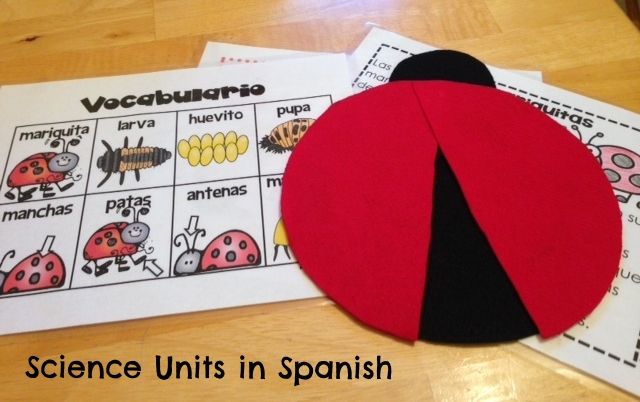
I bought this Teachers Pay Teachers unit in Spanish as the foundation of what I am teaching.  You can see some of the graphics for it in the above photo.

I also created a felt ladybug out of two large circles (one black and one red) and one small black circle.  We can use this ladybug and some black beans to do number activities with the "manchas" or spots on the back of the ladybug. Some ideas are to call out a number in Spanish and have the student put that many manchas (black beans) on the ladybug.  You could also do addition and subtraction with beans on the two wings.

Here is a site with some great ideas.  It is in English, but you can convert a lot of them to another language. Ladybug ideas

Tuesday, April 15, 2014

Spanish Units on Teachers Pay Teachers


If you have never checked out the site, Teachers Pay Teachers, hop on over there to see what is available for Spanish teachers.  Teachers Pay Teachers is a site where you can buy materials made by other teachers. I have found several teachers there who sell Spanish unit studies for the elementary level.  The units are not expensive.  Most of them are around five to eight dollars.  I love that I don't have to recreate the wheel!  I am planning this summer and in the fall to use some of these units as a break from our regular Spanish lessons.  Not only will my students be learning Spanish, but we will get to explore science a bit!  I am so excited!

Here are the units I am looking forward to using...

Ladybugs (which is part of what you see in the above photo)
Butterflies
Frogs (I have already been using this unit.  Love it!)
The Five Senses
Pumpkins
Polar Animals
Tropical Jungle
Landforms
Weather and Seasons
Insects

Wednesday, March 26, 2014

De la A a la Z {Country Books in Spanish}


Teaching about the different cultures and countries of Latin America can be tricky. While most of them speak Spanish that doesn't mean they have the same culture. What is normal and acceptable in Columbia maybe totally different in Bolivia. What is well known in Chile may never have been heard of in Mexico. Like my friend from Argentina who one day visited Mexico and ordered a tortilla and was shocked to find out that it was a type of bread.  To her a tortilla is a potato omelette.

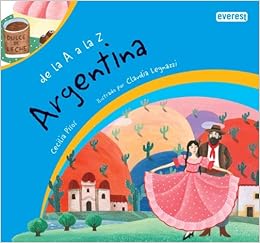
I recently came across a series of books for different Spanish-speaking countries. The series is called "De la A a la Z" (From A to Z). I decided to order the one about Argentina since I've lived there and am most familiar with their culture. I have to say I was really impressed with the book! There was a wealth of information in there to teach Argentine culture.


Each page takes a letter of the alphabet and connects it to an item in that culture. For example, the A is for Aconcagua in Argentina. The E is for empanada.  The M is for mate. Each page has a poem or rhyme in Spanish about the item and more information (also in Spanish) down at the bottom.  I was impressed to notice that even the correct Argentine vocabulary is used for simple items. For example, they use the word pollera instead of falda for skirt.  Most Argentines would use the first word instead of the second.
Here is a list of books in the series:

De La A a la Z Puerto Rico
De la A a la Z Peru
Argentina (De La a a La Z) 
De la A a la Z República Dominicana
De la A a la Z Guatemala 
De la A la Z Por Mexico
de La A a la Z Cuba
De la A a la Z Chile
De la A a la Z Colombia


Because these books are written totally in Spanish, they are better suited to older kids and those that are more advanced in the language. These would also be excellent books for native speakers to learn more about the countries they are less familiar with. They would be a great addition to a Spanish classroom! 


Tuesday, March 4, 2014

Shape Monsters

{Affiliate links used.  Thanks for supporting this blog.}

 Learning the names of shapes in another language is a great activity for preschool age kids or those in the lower elementary levels.  These are the shapes that I tend to teach my students...

El círculo-circle

El triángulo-triangle

El cuadrado-square

El rectángulo- rectangle

La estrella-star

La medialuna-crescent, half moon

El corazón-heart

El óvalo-oval

El diamante-diamond

I create little packets of colored shapes that I hand out to my students.  Their job is to create a shape monster or two with the shapes by gluing them together or onto a piece of paper.  I then have my students present their creations to me by telling me in Spanish what each body part is made of.  For example, "Los ojos son circulos."  or "El cuerpo es un diamante."  You can also have them tell you the colors of the body parts.

To create the shapes I used the following items:

Fiskars 196920-1001 Portable Paper Trimmer, 12-Inch (Good for creating the larger shapes with straight edges.  You will need a couple of  big shapes in each packet that can be used as bodies.)
Fiskars Circle Cutter (Good for bigger circles for the bodies)
Fiskars Shape Template, Ovals (Bigger ovals for the bodies)
Circle Punches
Square Punches
Paper Punch Set, Mini, Heart and Star

Triangles are easily made by cutting squares in half. Crescents can be made with by punching out circles and then hand cutting the curve out of one side of the circle.

I use astrobright paper to cut everything out, and then I pack Ziploc sandwich bags with a variety of shapes. Not every packet is the same and they aren't required to use all the shapes.  I just want them to be creative and come up with some kind of monster.  Such a fun and cute activity!

Books to Use with Shape Monsters

Fuera de Aquí, Horrible Monstruo Verde
El Monstruo de Colores
El Monstruo de los Monstruos


Tuesday, February 25, 2014

"Card Talkers" {Of Playing Cards and Conversations}


{Affiliate links used}

I have been using an activity that I named "Card Talkers" with my students to get them to ask and answer questions in Spanish. The activity also doubles as a cultural lesson because you can teach your students about how the deck of cards are different in Spanish-speaking countries.  In order to do this activity you need a set (or several sets for a classroom) of Spanish Playing Cards {La Baraja}. La Baraja is the name of the deck used in Spanish-speaking countries.  It is smaller than the English version containing only forty cards in all.  It also has different suits: oros (coins), bastos (clubs), espadas (swords), and copas (cups).  Traditionally, each of the suits represented a different part of medieval society.  The oros were merchants. The bastos were the peasants.  The espadas were the military, and the copas represented the Church.


The face cards are also different.  There is the sota (like our Jack), the caballo (horse/knight), and the rey (king).  Interestingly, there are no cards with the numbers eight and nine on them.


Once you have the cards, you can print out the files below.  The first page is more basic while the second page is for advanced students.  To use the cards and the questions, just shuffle the cards and put them face down in the middle of the group (no more than five students).  One student picks up a card and finds the appropriate question based on the suit and number of the card.  He or she then asks the person next to them the question.  That student answers and then picks up a card to ask the next student and so on and so forth.  I find that this activity works well at the beginning or end of a lesson.  It doesn't take a lot of set-up especially if you have the decks on hand.  I have laminated my question sheets so that they can be used again and again.  All you have to do is pull the materials out and get your students talking!

You can download the Basic Card Talkers here.

You can download the Advanced Card Talkers here.

Wednesday, February 19, 2014

Monster Drawings {Learning Body Parts}


One of the activities that I do with my students when they learn body parts are monster drawings.  I randomly give them about ten to fifteen body parts that they have learned.  The best way to do this is to have little slips of paper that have a body part written on them. They then pick ten of those slips of paper without looking at what is written on them. The students' job is to use only the body parts he or she selected and create some kind of creature with them.  They have to use all the body parts on the slips of paper.  So if they happen to get two papers with "los ojos" on them then they have to have four eyes on their monster.  Normally, I don't put the word "body" on any of the slips of paper as I want the students to be creative in coming up with a unique body based on another part.


After my students draw their monsters they then need to label the body parts in Spanish.  Finally they need to create a name for their creature, tell me where it lives and what it eats.

I have used this activity for years, and for the most part the students love it!  It is a great way for them to be creative while still working with the language.


Wednesday, February 12, 2014

Food People Drawings


{Artwork by Kaylee}

A simple, enjoyable exercise I do with my students when we learn food vocabulary is for them to make "food people".  They are required to ask a family member (this is what I do because I do private Spanish lessons) or a classmate for a list of ten foods that person likes.  If the conversation can be done in Spanish that is even better.  Once the student has ten items he or she is required to draw that person using only the items on the list.  Then they label the parts in Spanish.

Another activity is to describe their drawing to you or the class.  They can talk about what each body part or article of clothing is made of.  This helps review two more set of vocabulary.  For example, with the above picture you can say...

La cabeza es una zanahoria.
Los brazos sons las bananas.

Over the years I have seen kids do a lot of really creative pictures.  They even teach themselves new vocabulary like rhubarb! {See the picture above to find it.}  Be prepared to be amazed by the creativity!

Need more ideas to teach foods? Click here.