Saturday, January 23, 2016

Story Cubes for Verb Conjugations


{Affiliate links used}

Anytime as a teacher you can give your students another fun way to practice what they are learning you have succeeded! I am constantly looking for other ways to help my students practice Spanish in unique ways. Verbs tend to be one of the hardest concepts to master in Spanish because there are so many forms. So I was delighted one day as I walked down the aisle of a local store to find Action Story Cubes! There are nine dice in the set each with a small picture of an action on each side so that's 54 different verbs! Here are some ways they can be used when teaching another language...

-Create cards that have the subject pronouns on them {I, you, he, she, etc.}. Place them face down on the table. Then have your students roll the dice {They can roll one or all of them.} and pick up one subject pronoun card. They then pick a verb {if they rolled more than one die} and conjugate that verb according to the subject pronoun card.

-For more advanced students, add another set of cards with the names of the tenses on them {present, past, future, conditional, etc.}. Now the students must conjugate verb according to the subject and the tense on the cards.

-For beginners, have the student roll all the dice and see how many actions they can name.

-Roll the action dice along with other Story Cubes. Have them create sentences using at least one action and one other cube. NOTE: Each set of cubes is in a different color which makes it easier to separate out the sets later and for your students to see which are the action cubes and which are the regular ones. 

All of the above activities can be used with small groups. If you teach a larger number of students you can break them down into groups of four or five. Because monitoring what students are doing in several groups is hard, I would sometimes have them write down their answers from what they did. Later you can go back and briefly check their papers to see if they were understanding. Writing what they came up with is particularly great if they are creating sentences. 


There are several sets of Rory's Story Cubes, here's a list of all of them that you can choose from...

Rory's Story Cubes-The original set
Rory's Story Cubes Actions
Rory's Story Cubes - Voyages- These are awesome! Pictures of a camera, cave, circus tent, mountains, and so much more!
Rory's Story Cubes Mix- Enchanted, Prehistoria, Clues-Pictures related to fairy tales, dinosaurs, and crime investigation.
Rory's Story Cubes - Original, Actions, Voyages, Prehistoria, Enchanted, Clues (Set of 6)- This includes all the sets!

Come back tomorrow and read about how I use these cubes to encourage my students to write in the target language. There will also be a free printable!!



Friday, January 22, 2016

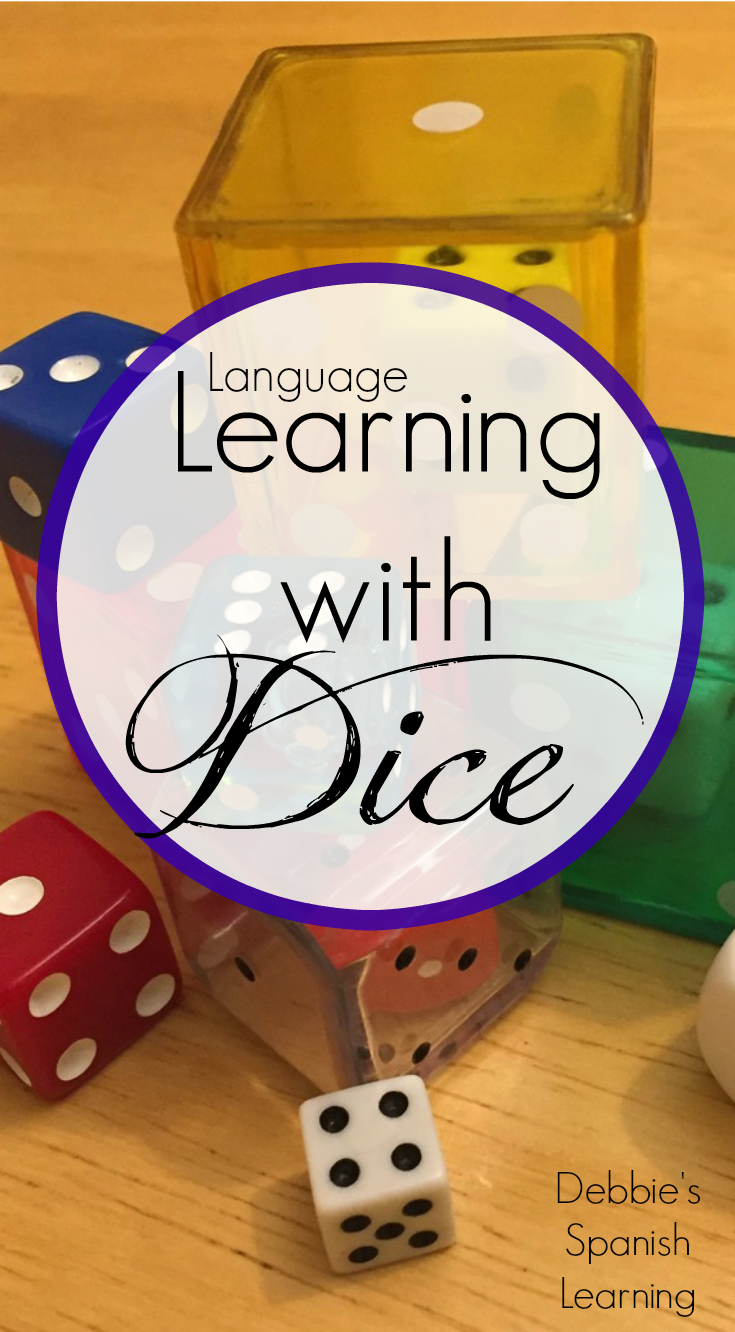
Using Dice in Language Teaching

{Affiliate links used.}

{NOTE: This is a re-post with added information and ideas.}

I love making language learning into a game if possible. Even if the activity we are doing isn't really a game, dice give a hands-on experience to what we are practicing in the language.  There are several types of dice that I use when teaching.


Dice Within Dice are great for practicing sentence constructions, verb conjugations, and adjective/noun agreement.  On my whiteboard I will normally make two lists.

COLOR
1. Uds.
2. yo
3. Carla y yo
4. ella
5. tu
6. Ud.

BLANCO
1. decir la verdad
2. hacer la tarea
3. pedir la comida
4. encontrar un gato en la calle
5. salir con amigos
6. perder los libros

Students takes turns rolling their "Die within a Die" and creating a sentence.  For example, if a student rolled a "2" for the colored die and a "4" for the white die, the sentence she would need to come up with would be "Yo encuentro un gato en la calle."

One way to mix this activity up a bit is for the teacher to participate.  I roll the dice and then say the sentence, but I don't always do it correctly.  It is the students' job to figure out if the sentence is "correcto" or "incorrecto".

This method could be done with lots of types of sentences.  Here are some ideas:

-Subjects and adjectives {Ella es flaca.}  Great for practicing noun/adjective agreement.

-Subjects and items we know.  {Ella sabe bailar.   or  Yo conozco a la profesora.}  This is great for practicing the difference between saber and conocer.

-Subjects and adjectives-some that take ser and other estar.  {Nosotros estamos aburridos.   or  Uds. son altos.}

-Even more complex sentences can be done if you give the students three dice (or one die within a die and a single separate die).  For example...
Subjects-objects-recipients of the objects {Yo le doy la bici a Ricardo.}  Or use double object pronouns...{Yo se la doy.}

-Also with three dice:  Subject-preposition-place  {Yo estoy a la derecha de la silla.}

-With four dice or two dice within dice...
subject-verb that takes subjunctive-subject-second verb  {Yo quiero que Carlos haga la cama.}

-Or how about practicing different verb tenses? Use three regular dice...Subject-verb-tense to see if your students can conjugate into the correct mood or tense.

NOTE: Sometimes when working with big groups of students I break them down into groups of four and have them write down the sentences they create to have a record of what they did in their groups.


Blank White Dice hold a plethora of possibilities!! You could write subject pronouns on them to work with sentence building. Or maybe you want to write the names of tenses on them to use. Another idea is to write the infinitives of verbs especially the irregular ones that need tons of practice.


Number Dice are great for practicing saying the numbers out of order.  It is great when a student can learn to count in Spanish or another language, but the true test is when they can see the number and tell you what it is.  Sure, students for awhile might have to "count up" to tell you the number, but the more they practice the easier it gets.  I use one to four of these dice and have them roll them all at once. Then they have to line them up and tell me what number they have. Great for older students needing to practice higher numbers like 4,350 or 1,642.

Another option is to have a group of number dice on the table and then call out a number that the student then has to create with the dice.


Math Operation Dice along with regular dice can be used to do math problems in the target language.


Thursday, January 21, 2016

Cards and Conversations {Part 2}

{Affiliate links used.}

Earlier this month I posted about using a deck of Spanish Playing Cards and some printables I have created in order to get your students asking and answering questions in Spanish. I promised you one more printable which will be towards the end of this post, but first take a look at these posts if you aren't familiar with this activity...


Here is the fourth printable. Download it and get your students talking!!

Want more foreign language teaching tips? See my whole series.


Wednesday, January 20, 2016

False Cognates in Language Learning

{Affiliate links used.}

For those of you who aren't familiar with what I do I run an in-home business teaching Spanish to mostly kids (and some adults). Each month I decorate a door that my students have to use to get in for their lessons. I put up comics in Spanish, fun language facts, and sometimes these little posters I created of some of the "false friends" or cognates in Spanish.


Also, I sprinkle throughout my teaching information on words that look like a word in English, but have a totally different meaning in Spanish. I figure it is my duty to keep students out of embarrassing situations by knowing the real meanings of the Spanish words. Working with cognates also increases vocabulary for a language learner. Not only does a student get familiar with the cognate, but he or she can learn the "real" word. For example, a student learns the word "vaso" and that it really means "glass". In the process he or she can be introduced to the word "florero", the real word for vase in Spanish.

Here are some resources for cognates and false friends:

Dictionary of Spanish False Cognates- What an awesome book!! I had no idea this existed! An excellent resource for teachers and students.

An Infographic on Spanish Cognates


Playing Loteria /El juego de la loteria - This bilingual book shows the special bond between a grandma and her grandson. The concepts of cognates comes up in the story.


Free Cognates List (Spanish and English)


Tuesday, January 19, 2016

Seven Ways to Use Word Clouds in a Language Classroom

{Affiliate links used.}

I love the word clouds you can find on Pinterest in Spanish! Many of them I have printed out and displayed for my students. {Here is my Pinterest board on word clouds.} There are other activities you can do with these graphics to help your students learn some new vocabulary and work with the words. Here is a list of ideas:

Have them pick 7-10 words and do some of the following activities...

Draw pictures of the selected words.
Define the words using the target language.
Write a story using the words.
Draw a scene using the vocabulary. Label it in the target language.
Spell the words {in the target language} to a classmate and see if they write them down correctly.
Pick verbs in the cloud and have them conjugate them in certain tenses.
Use the letters in the selected words to spell new/other words in the target language.

Or...

If the words in the cloud are different parts of speech have your students categorize the words into nouns, verbs, adjectives, etc.

You and/or your students can create word clouds using one of these two programs: Wordle or Tagxedo.

Have any other ideas on how to use these? I would love to hear them.

Need other ways to motivate your students? How about using comics or story cubes in your classroom?


Monday, January 18, 2016

Teachers Pay Teachers


A few years back I discovered Teachers Pay Teachers and fell in love with the site.  Much to my delight their were tons of Spanish resources! While I don't sell my materials on the site I have greatly benefited from downloading freebies and paying for resources I want to use with my students. I will highlight a few resources so you can see what type of materials are available. It is so worth it to spend some time taking a look at all that is offered to Spanish teachers!

Free items


Christmas Vocabulary Activities - These are awesome! I used them this past December. You can read about it here.

Hundreds Chart Mystery Picture - I love these to review numbers and colors. Here is how I do it.

Mafalda Body Parts Exercises - A great review of body parts using the famous Argentine comics character, Mafalda.


Paid Products

These are items I have paid for and used. Really, there is so much on this site that when you get to a certain topic you need to teach all you need to do is search.

Ocean Animals - I will be using these soon in an ocean unit for my younger students.

Spanish Shoe Verb Exercises - Great review for high school students.

Synonyms in Spanish - A way to increase your students vocabulary base. 


Spanish Plurals Worksheets - Lots of practice!

Spanish Speaking Countries and Capitals - Activities and quizzes

As you can see there is a wide variety of resources. Since I teach students from the age of four all the way to adults, I need a variety of activities with different skill levels. Teachers Pay Teachers has definitely made my life easier when it comes to prep and planning! Check it out!


Sunday, January 17, 2016

Activities with Children's Books

{Affiliate Links Used}

If you have read my blog for any amount of time you know that I LOVE children's literature. I use it every day with my elementary students when I teach. Throughout my website I have several posts on how to take a book, read it to your students, and then do learning activities related to the story. Here is a list of what is currently available.

La Oruga Hambrienta is the book I use with young kids to introduce the days of the week. Here is a free printable activity to do with the book.

Si Quieres Ver Una Ballena is a sweet book with a boy that gives advice on how to see a whale. I have read this book to my students and then done this drawing activity with them.

Pinta Ratones can be used to introduce simple color theory to kids.

Here is a more advanced book with another color mixing activity.

Here's a great book to review prepositions and food vocabulary. A simple drawing activity is included. 

Oliver Jeffers' book, Arriba y Abajo, has opportunities to teach new vocabulary.


This sweet book about taking the moon for a walk is a great way to review the names of animals.

La Casa Adormecida allows you to review prepositions with young kids.

Atrapados is another awesome book by Oliver Jeffers. At the end of this post is an activity to review the vocabulary introduced in the book.

Se Venden Gorras has several learning opportunities with colors, patterns, and sorting.

To review numbers 1-20, use Un Alce, Veinte Ratones