Wednesday, June 11, 2014

Insect Unit in Spanish


This summer I am working with several students to teach them more about insects and creepy crawlies in Spanish. I am using several resources: books, units from Teachers pay Teachers, and some of my own ideas.

Here are some great books that I own and have used with my students...

Mi Pequena Enciclopedia Larousse Los Insectos-I LOVE this little book filled with information on different insects.  Great for younger kids, but also for upper elementary that are learning Spanish.

La oruga muy hambrienta-A classic

La Mariquita Lara-Simple story of a ladybug that loses her spots.  Early elementary.


¡Montones de mariquitas!-Great book for teaching kids to count by 5's using the spots on ladybugs.

Correle, correle ciempies! -A book from the same series as Montones de Marquitas.  This one uses a centipede and teaches counting by 10's.

Super Catarina Y Los Super Insectos-Longer book for upper elementary


                      {Sidewalk Chalk Critters}

Activities

One of the activities I do with my students is play Memory with these cards. After we have played and they are somewhat familiar with the words, I have the students draw the critter I call out in Spanish (from the Memory game we just played) with sidewalk chalk.

Here is a prior post of mine with ideas for activities with ladybugs.  You will also find links on this post to units in Spanish on ladybugs at Teachers pay Teachers.

These insect hundreds chart mystery pictures are a cool activity! I use these sheets by calling out the numbers and colors in Spanish so that my students can color in the picture.


This game reviews numbers, colors, shapes, and size.  It could be modified to play it in Spanish.  Click on the picture for the link.


The Very Hungry Caterpillar - Ideas to teach the days of the week in Spanish

Tuesday, May 20, 2014

Teaching Rhyming Words


This coming fall I will be working with my younger students on rhyming words in Spanish.  There are several great sets of rhyming word cards available at Teachers pay Teachers. This is the set that I bought.  There are 100 words (50 rhyming pairs)!!  I made them into cards by adhering colored paper to them and then laminating them.  I have separated them into groups of ten (so five sets). I will be teaching my students the sets one at a time.  This will improve their vocabulary, teach them about the sound system in Spanish, and start them on the road to reading the language.

There are several things that you can do with these cards:

-Memory

-Go Fish

-Lay the cards out on the floor.  Call out a card.  A student has to find that card and its rhyming mate.

-The Slapping Game (No slapping of each other!!): Lay out the cards on the floor.  Call out a word.  The first student to put their hand on the correct card gets to keep the card.  The goal is to have the most cards at the end.  You can vary this by calling out a word on a card, but they must slap the rhyming word for it.

-Lay out the cards and spell a word in Spanish (provided your students already know the letters) and see if they can find the card.  Then can they find the rhyming word and spell that for you?

-Use picture dictionaries like Everyday Words in Spanish . Call out a rhyming word and  see if they can find it in the dictionary.

-Use this page at the end of learning all the words. Give your students colored pencils and the page. Call out a color in Spanish and then one of the rhyming words and have them color it in.

Here is a cute idea from another blog to do with rhyming words...rhyming snowballs or falling leaves.

{Affiliate links used. Thanks for supporting this blog.}

There are also bilingual books and books in Spanish that focus on rhyming like Huevos verdes con jamón. Or El viejo y su puerta  which is a cute book about an older man that misunderstands his wife.  She asks him to bring "la puerca" to the BBQ, but he ends up bringing "la puerta". This book can be a springboard to talk about how the change of one sound (which happens with a lot of rhyming words) can change the whole meaning!

There is a great series of bilingual books that have a plethora of rhyming in them.

Say Hola to Spanish
Say Hola to Spanish, otra vez
Say Hola to Spanish at the Circus

El loro tico tango is another great story with lots of rhyming.  Can your students pick out the rhyming words as you read it?

Have fun rhyming!


Wednesday, May 7, 2014

Teaching Compound Words {Games}


I am getting ready for my fall Spanish lessons.  I know...it seems strange to be working in May for activities that will happen in September, but I have found that it is the best way for me to stay on top of things. Yesterday I posted about working with compound words in Spanish. I am planning on doing this with any of my students that have already been introduced to the present tense.  Most compound words in Spanish involve a verb that is conjugated in the he/she form so a little background in verbs helps.

I created a set of cards to play a few games.  Basically, the first half of the word goes on one card and the other half on another {see below}. I put all the first halves on yellow cardstock and the second halves on orange because I did close to thirty words.  This way they will be easy to sort. Now I can play Memory {It won't be as overwhelming because the cards are on two colors.  They will know to always pick two of each color.}, Go Fish!, and even test my students with the cards by laying out the first halves and letting them put the second halves on top.


Any other great ideas?  How do you teach compound words?

Tuesday, May 6, 2014

Teaching Compound Words {List and Activities in Spanish}


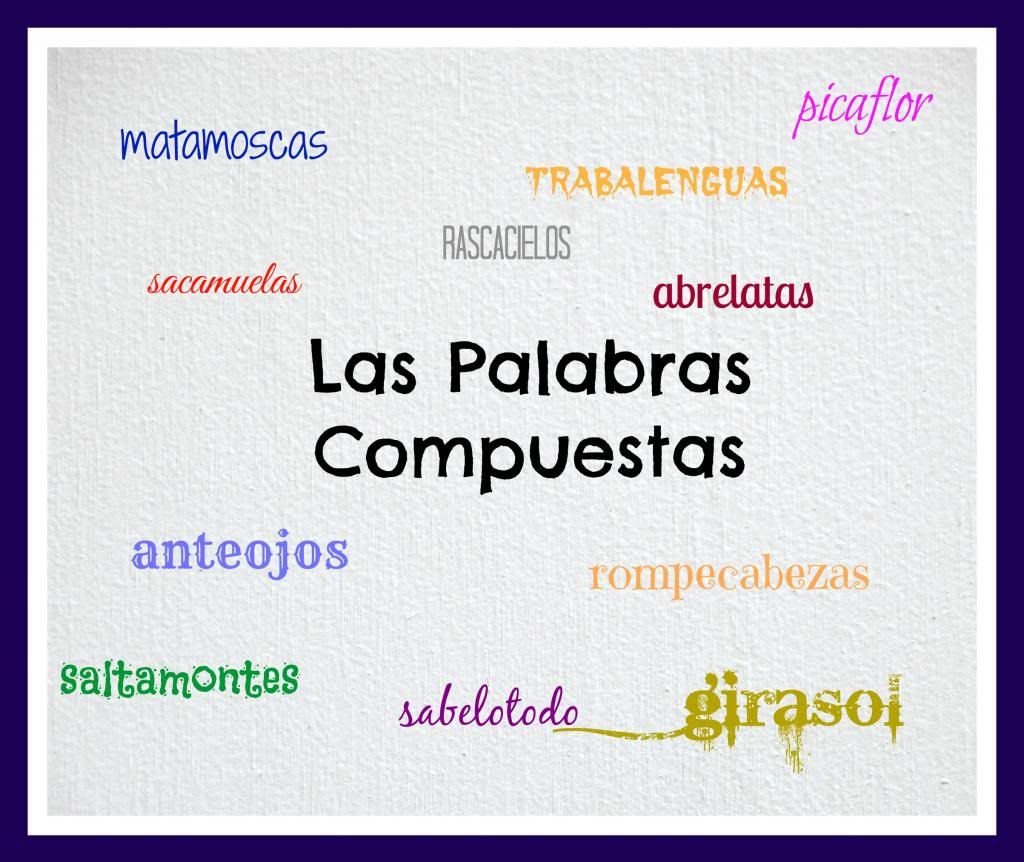
I love words! I guess as a language teacher I should.  In particular, it is fun to see the real meaning behind words.  This past week I have been setting up a compound words unit for my intermediate and advanced students. My goal is to increase their vocabulary base and get them thinking about how we don't always express ourselves in the same way.  What may be a grasshopper in English becomes a "mountain hopper" in Spanish.

I chose thirty compound words in Spanish and created worksheets like these...


The worksheets require students to look up the two (or three) parts of the word in Spanish and translate them.  They then take the second page and cut out the picture and put them by the correct word after the bubbles.  By the time they are finished they have gained ten new vocabulary words and have learned five compound words. It is interesting to see how differently things are said in another language. Instead of a scarecrow you have a "scarebird" in Spanish. Instead of a dropper you have a "drop counter".

Here is the list of words I used...

abrelatas
rascacielos
anteojos
matamoscas
picaflor
parasol
lavaplatos
salvavidas
cuentagotas
parabrisas
cumpleaños
sabelotodo
espantapájaros
paraguas
rompecabezas
trabalenguas
tragaluz
cascanueces
calientalibros
lavamanos
saltamontes
ciempiés
guardaespaldas
matasanos
telaraña
sacamuelas
girasol
paracaídas
parachoques
camposanto

If you would like to introduce the concept of compound words to younger kids then read to them
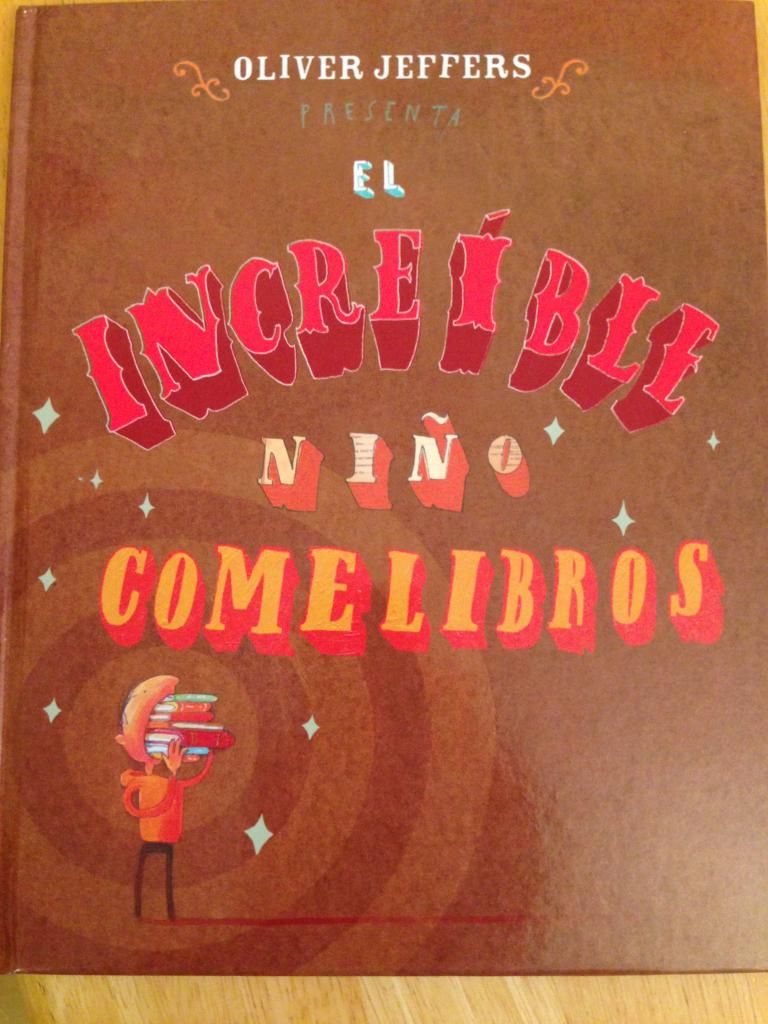
El increíble niño comelibros. While it doesn't have a lot of compound words in the text there is one in the title, Comelibros (book eater). After reading the book you can talk about how many compound words are formed...a verb in the he/she form (present tense) and a noun in the plural form.

Come back tomorrow to see my post on games you can do with compound words.

Friday, May 2, 2014

Teaching Geography in Spanish


{Affiliate links used.  Thanks for supporting this blog!}

I have several students that are fascinated with maps!  This past spring I used their interest in geography to work with maps and increase their vocabulary in Spanish.  Here are some available resources...


World Foam Map Puzzle-This puzzle is in English, but I use it with younger kids.  As we are putting the puzzle together I name the continents, oceans, colors, and the animals in it in Spanish.  When the puzzle is complete I teach north, south, east, and west.  I also will call out a place in Spanish for them to find.  Once their finger is on that location, I give them a direction.  They move their finger in that direction until I say "Para" (Stop.).  They then have to tell me where they are at in Spanish.  If they don't know the name in Spanish we go over it.

Landforms Unit- This unit can help you teach concepts like mountains, deserts, lakes, etc.

Mi primer Atlas / My First Atlas (Spanish Edition)-This is a great atlas for elementary-aged kids.  All in Spanish! It has physical and political maps of the continents.  I love that you get all the names of the countries in Spanish. There are tidbits of cultural information along with facts on the environment and economics.

Bilingual Puzzle Map of Mexico

North America Map Bilingual Puzzle

Pequeno Mundo: Geografia-Series of books with geographical concepts

Mapping Activity

My Place in the World Activity

Continent Booklet

Compass Rose

Flag Game- Print out the flags of all the Spanish-speaking countries.  When you cut out the flags don't leave the name of the country with it.  You want only the flag.  Put them on cardstock.  You can now play the "slapping game" with a small group of kids.  Lay out the cards.  Call out a country.  The first student to put their hand on the correct flag collects that card. The student with the most cards at the end wins.  When I play with my students I do tell them to be gentle!  Just because we call it the slapping game there should be no slapping of fellow students' hands!

Memory or Go Fish- You could also create these games with the flag cards.  For memory use one card with the flag and the other matching card can be the name of the country in Spanish.  For Go Fish you can create sets of four (four cards with the same flag).  The student has to collect all four to gain the set.


Tuesday, April 29, 2014

Ladybug Unit {in Spanish}

{Affiliate links used. Thanks for supporting this blog.}

This summer I am doing a ladybug unit with one of my students.  I thought I would share the resources that I have come up with for doing a ladybug unit in Spanish.

Here are some books in Spanish to read during the unit:


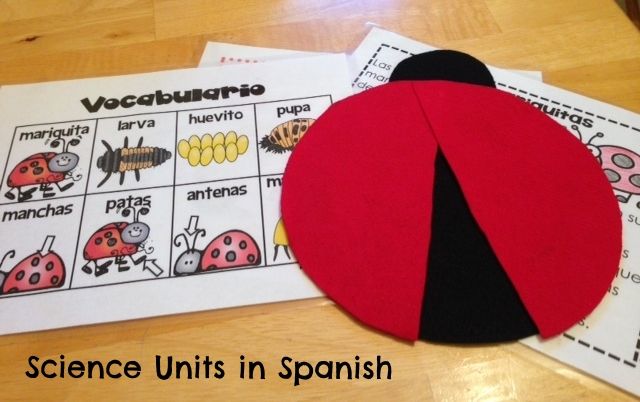
I bought this Teachers Pay Teachers unit in Spanish as the foundation of what I am teaching.  You can see some of the graphics for it in the above photo.

I also created a felt ladybug out of two large circles (one black and one red) and one small black circle.  We can use this ladybug and some black beans to do number activities with the "manchas" or spots on the back of the ladybug. Some ideas are to call out a number in Spanish and have the student put that many manchas (black beans) on the ladybug.  You could also do addition and subtraction with beans on the two wings.

Here is a site with some great ideas.  It is in English, but you can convert a lot of them to another language. Ladybug ideas

Tuesday, April 15, 2014

Spanish Units on Teachers Pay Teachers


If you have never checked out the site, Teachers Pay Teachers, hop on over there to see what is available for Spanish teachers.  Teachers Pay Teachers is a site where you can buy materials made by other teachers. I have found several teachers there who sell Spanish unit studies for the elementary level.  The units are not expensive.  Most of them are around five to eight dollars.  I love that I don't have to recreate the wheel!  I am planning this summer and in the fall to use some of these units as a break from our regular Spanish lessons.  Not only will my students be learning Spanish, but we will get to explore science a bit!  I am so excited!

Here are the units I am looking forward to using...

Ladybugs (which is part of what you see in the above photo)
Butterflies
Frogs (I have already been using this unit.  Love it!)
The Five Senses
Pumpkins
Polar Animals
Tropical Jungle
Landforms
Weather and Seasons
Insects