Showing posts with label Alphabet. Show all posts

Tuesday, October 18, 2016

Teaching the Sounds of "C" and "G" in Spanish


{Affiliate links used.}

Lately, I have been noticing that my students struggle with knowing which sounds to use when they see words that contain "C" and/or "G". Both of these letters are "vowel dependent" meaning the vowel that comes after them dictates their sound. To learn more about how "C" and "G" behave there are two great videos online:

The Letter G
The Letter C

I used these following units from Teachers Pay Teachers to create decks of cards. One deck has "C" words, and the other contains "G" words. I made two cards for each word so that I could play Memory, Go Fish, and the slapping game with my students. (With the slapping game, I lay out the cards on a hard surface and call out a word and they have to put their hand on the card before other students in order to capture the card. The student with the most cards at the end wins.)  These cards also double as flashcards in which your students can practice reading the words. These cards are great for early elementary kids. Here are the units I used:

GE and GI Words
GA, GO, GU Words
CE and CI Words
CA, CO, and CU Words

Another great tool is the story El Nabo Gigante, which contains a plethora of "C" and "G" words. Here is my post on how to use this book to work with these words. Here are a few other books that have a higher frequency of "C" and "G" words:

Carros, Camiones, y Aviones
El Ratoncito, La Fresa Roja Y Madura Y El Gran Oso Hambriento

There is also a Crazy Eights game available here that specifically focuses on these words! This would be for slightly older students who are reading Spanish for the most part, but struggling with the sounds of these two letter.

By taking a little extra time to focus on these words, it is my hope that my students will gain a better understanding of their sounds as they read the language.

Thursday, April 7, 2016

¡Caramba! Game

{Affiliate links used.}

I am closing out the school year with my Spanish lessons and wanted a way to review the vocabulary we have been working on. I came across on Pinterest a post about Kaboom! It was created for elementary classrooms, but I thought it would be perfect for language learners also! So here is how you go about it:

First of all you will need...

Jumbo Craft Sticks
Sharpie Markers
Cups (Not see through)

Since I work with a lot of different levels of students I had several categories of vocabulary I wanted to use like house items, the alphabet, clothes, opposites, etc. I decided to color-code the sticks  on one end. This helps with two things. Kids will know how to put them in the cup with the colored part sticking out. This allows me to  select which sets of vocabulary to use with certain sets of students. For example, I know that the orange sticks are emotions and the pink sticks are foods. {See the final set of pictures for the list I made for myself.}


After you color the tips, you write one word towards the other end of the stick. I tend to use about 15 sticks for a vocabulary-themed set. Three of those sticks will have the word "Caramba" written on them. The rest will have vocabulary words you want kids to review.


To play the game you put one set (or maybe two or three if you have more advanced students) in a cup with the colored tips up. Students take turns pulling a stick out of the cup and giving the translation of the word. They keep the stick if they can say what it means in English. Otherwise, they put it back in the cup if they don't know. If they pull a "Caramba" stick they have to put back ALL their sticks! I time the game for about three minutes. The student with the most sticks at the end wins!

This is a fun way to review vocabulary which at times can be tedious!


Wednesday, February 24, 2016

Bananagrams, Dígame, and More

{Affiliate links used.}

I love adding games into my language teaching. Games break up the monotony and give students an alternate way to learn. Over the past few weeks, I have been buying some new games to add some spice to my lessons. Here's a quick look at the ones I am using...


I am looking forward to using Spanish Bananagrams  with my students today. I bought it because I read about it at Spanish Playground. {I LOVE her teaching tips and ideas!} I am not going to re-invent the wheel in trying to figure out how to use this with my students when she has written this stellar post with ideas on how to incorporate it into your lessons. You just have to check out this post! You can find it here.


For about two weeks now some of my students and I have been playing KLOO. {Here is my post about these games.} I am loving how these teach kids vocabulary as they play. Students don't need to have an extensive background in the language to enjoy this game. They need to be able to read well in English and sound out the Spanish words. I actually played this game yesterday with two girls who have only been studying Spanish for a couple of months! There are two different sets you can buy (each set has two decks).

KLOO's Learn to Speak Spanish Language Card Games Pack 1 (Decks 1 & 2) {Food and Clothing}

KLOO's Learn to Speak Spanish Language Card Games Pack 2 (Decks 3 & 4) {Everyday Objects and Places}

KLOO's Learn to Speak Spanish Language Board Game - Race to Madrid {The board game version with all four decks}


Finally, I have one more game waiting in the wings to figure out. I hope to "test drive" it with my husband and son (both speak some Spanish) this weekend. It is called ¡Dígame! . It looks like a lot of fun, and I love the idea that it is all done in Spanish! Here is a video about it. I will post more about it as I get more experience with how the game works.

Have fun playing and learning!


Tuesday, December 17, 2013

Ten Ways to Use Picture Dictionaries in a Language Classroom

{Affiliate links used.  Thank you for supporting this blog.}

Picture dictionaries are a great jumping off point for conversations in the target language you are teaching.  I love using the types of dictionaries that have "scenes" that you can use to talk about many different topics.  The dictionaries I have listed here are {at the time of this posting} out of print {at least the Spanish versions are...other languages are available}, but they are readily available on the used market through Amazon and other sites.

Picture dictionaries with scenes can be used in a variety of ways.  Here is a list of ideas:

{NOTE: All of these activities are done in the target language...on both the teacher and student side.}

1. Ask where certain items are in the target language and the student points them out.

2. Counting items on the page.

3. Show them a scene and they have to describe it in the target language.

4.  Practice prepositions by describing where things are located.  I normally do this by giving the student(s) two items in Spanish.  They then have to tell me how the first item is positioned in regards to the second item.  For example:  El gato esta encima de la mesa.

5. Call out an item and the students give you an adjective for it.

6. Have the students describe the actions going on in the scene.

7. Discuss the emotions of the people in the scene.

8. For pages with lots of food pictures on them call out a color and the students tell you the foods that are that color.

9. Also, for food pages, call out an adjective like sweet or salty and have students list foods that fit that description.

10. Call out a letter of the alphabet and see if students can list any items on the page that start with that letter.


Let's Learn Spanish-Picture Dictionary-I love this dictionary particularly for its opposite page {see above}.  With this page I ask questions like, "Where is the fast mouse?"  "the tall mouse?", etc.


First Thousand Words in Spanish-This dictionary is the one I have used the longest in my teaching.  Scenes in the middle with vocabulary around the sides.


Everyday Words in Spanish-Most of my younger students love this book with claymation type characters. Once again there are scenes with vocabulary on the sides.
You can probably find another million ways to use these books.  I would love to hear your ideas!

Friday, November 22, 2013

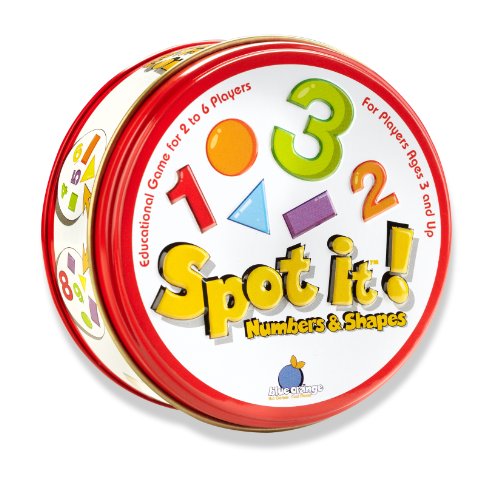
Spot It! Games for Learning another Language

I love using games that are already prepared for me in my Spanish lessons.  I recently came across Spot It!  I have been using it with my students and they are loving it.  At first, I feared it wouldn't work if my students didn't know all the vocabulary on the cards, but I have found that this isn't a problem.  The game actually teaches and reinforces learning!  It is also fast moving which brushes away any boredom your student(s) may have. Without fail, I have parents who watch me play this with their kids and then have to go out and buy it. It is that good!  This game would also be a great time filler in a classroom for students that finish early.

Here is how it works:

Each card has several pictures on it.  Any two cards in the deck have a matching picture.  The goal is to be the first one to call out the name of the picture. I have modify the rules a bit for my language learners.  If they spot the match, but can't remember the word they need to point to it.  I then supply them with the word.  It only takes a few times of supplying the word before they remember.  The more you play the more they learn.  Students are highly motivated because they want to be able to call out the word first!

There are several versions of this game...


Spot It! Numbers and Shapes

Spot It! Alphabet
Spot It (The original game)

Spot It Junior Animals (a favorite of my students)

There are also several other versions that have very specific vocabulary.  There is a baseball, hockey, Halloween, and road trip version. There is even a Spot It! Basic Spanish! Check them all out!

Tuesday, November 12, 2013

Teaching the Alphabet in Spanish

Teaching the alphabet can be a whole lot of fun!  There are so many activities out there to reinforce the names and sounds of the letters.  Here are some ideas that I have used when teaching the Spanish alphabet to preschoolers all the way to highschoolers...


If your child or student is young enough you will want to start with letter recognition and formation. After I have introduced the letters through Spanish Alphabet Flash Cards, I will call out letters and have the student create them with playdough or build them with felt or wooden shapes.  Here is a file to help you create the shapes for the felt or wooden letters.


Another idea is to use Paper Letters for various activities.  Here is a list of what can be done with them...

-Hide the letters and then call out a letter that they need to go find.

-Mix up the letters and have them put them in order.  Review their Spanish names once they are in order.

-Spell Spanish words with them and see if your students can create the word you spelled.

-If using different colored letters, call out a color and they collect all the letters that are that color.  The students then have to tell you in Spanish which letters they collected.

-Have them create their names with the letters and then tell you what letters they used.

-Hide the letters.  Give them instructions on where to find each letter.  For example:  La "a" esta debajo de la mesa."  To make this more challenging you might hide two or three different letters in the same spot.  They have to retrieve the correct letter.


Alphabet Shape Stickers can be used in a variety of ways.  I use picture pages like the one you see below from Basic Vocabulary Builder.  I tell my students in Spanish which letter sticker to put on which picture.  This way they are not only reviewing letters, but other vocabulary.


Spanish alphabet books can enhance your unit on letters also.  Here are a few...

Gathering the Sun: An Alphabet In Spanish And English (Spanish Edition)-for older students
Albertina Anda Arriba: El Abecedario / Albertina Goes Up: An Alphabet Book (Bilingual Books)
A is for Airplane/A es para avion
Calavera Abecedario: A Day of the Dead Alphabet Book
ABeCedario Nutritivo

Here are a few more activities:

-I also do a fly swatter or "slapping" game.  I make cards with a letter on each card.  I use the complete Spanish alphabet and a few duplicates (like I may have two or three cards each of several of the letters).  I then lay out all the cards on a table.  I call out a letter and the first student to slap the correct card either with his or her hand or a flyswatter gets the card.  The student with the most cards at the end wins.

-Make a set of cards to play "Go Fish"  (Pesca) with the letters. Have the students play in Spanish by asking "Tienes la "c"?"

-Have the students use a Spanish dictionary to find unique words.  They have to spell the words to you in Spanish.  See if they can stump you with a new word you don't know.  My high school students love this activity and I have increased my vocabulary by doing it!

What other ideas do you use to teach the alphabet in Spanish?