Showing posts with label Colors. Show all posts

Monday, January 29, 2018

Teaching Young Kids Spanish Numbers 11-20


{Affiliate links used.}


When it comes to counting in Spanish, once kids have 1-20 memorized the numbers up to 100 become easier. Most kids in the US already know 1-10 in Spanish or at least most of those numbers. Eleven through twenty tend to be more challenging. Last week I did a simple activity with some of my young students to get them counting and help them memorize their numbers. The key ingredient? STICKERS!

There is something motivating about stickers for kids. While there isn't much prep to this activity it does require stickers in bulk. I also prefer to have different colored stickers so that we can practice the colors. Just a word of warning...we found that stickers shaped like stars or other intricate cutouts are harder for young hands. The rounder ones worked better. Here are some resources:

Colored Smiley Faces
Colorful Paw Print Stickers
Star Stickers (these are actually round stickers)
Multi-Colored Stickers
Multi-Colored Stickers II
Dinosaurs
Furry Friends

I cut sheets in half to hand out to students making sure I cut them so they have a variety of colors. Each students will need several (about four) half sheets. I also provide each student with a piece of paper with the numbers 11-20 written down the side (see above picture). I then call out a number and color (the color is optional) and the students have to find that number on their paper and put the correct number of stickers in a line by that number. They are required to count in Spanish while they do this.

So here are some tips for this activity:


  • Make sure you have already spent some time working with the numbers. Don't do this activity right after introducing 11-20.


  • The stickers are highly motivating. I tell my students that as I walk around and listen if I can hear them counting in Spanish they will get extra stickers at the end to take home.


  • Be prepared for some students to lose track as they count and get a little frustrated. Some students can count and not lose track; others struggle because they are hearing their classmates around them counting and then they lose track. To deal with this it is best to separate students so they aren't so close together. I also help those that lose track by counting with them from time to time. It can be a struggle, but in the end they learn the numbers really well.


  • I don't do all the numbers 11-20 with stickers. The activity would be way too long for young kids. So I do about seven of the numbers and the rest are left blank or they can do them at home. I make sure I call out the number 20 so that they get practice going through all the teen numbers.


  • Walk around and listen to them count! Help if they get stuck. Recount with them if need be. 


Soon they will be counting to twenty with ease!

Monday, September 18, 2017

Clothespin Monsters and Language Learning


{Affiliate links used.}

I am always looking for new ways to teach Spanish vocabulary I have taught for years. It adds spice to my lessons and also keeps the teacher (me) engaged. Last week I came across this post on making little monsters and decided to make them in all the colors that I have taught my students. I also laminated them and used this glue (click here) which is incredibly durable. In the post, she suggests playing games with pom poms (find them here) with the monsters. I am using the monsters and the pom poms to review colors. Here's how I do it:

I lay out all the monsters on the table and then give instructions in Spanish like "El monstruo rojo come azul." One of my students then needs to find the red monster and use him to pick up a blue pom pom to deposit in a nearby cup. Once I have done this enough with students, I then ask them to "be the teacher" and give instructions to fellow classmates. 

Another activity is to have small disposable bathroom cups for each child. Lay out all your pom poms on a table. Each child gets a clothespin monster to use. Time them for thirty seconds or one minute and have them fill their small cups with as many pom poms as possible using only the monster to get them in the cup. When time is up, have them count the pom poms in their cups in the target language and tell you how many they got.


I also have doll clothes that I use for teaching which can also be used with these monsters. Give students instructions on which colored monster is going to eat which article of clothing. Have them deposit the clothes in another container that serves as the "stomach" for the monsters. Actually, these monsters can be used for all kinds of vocabulary in this same manner as long as you have something for the students to pick up with them. 

If you have any more ideas on how to use these monsters in a language classroom I would love to hear them! 

Sunday, June 18, 2017

Spanish Camp for Kids {Day 1}


{Affiliate Links Used}

For the first time ever, I am going to be doing summer camps for Spanish! I am really excited about it as I will have time to do some of the extras (like crafts) that I can never seem to get to. So here's a look at what I have plan for Day One (two to three hours worth of activities)...

Today we will be doing introductions and then really focusing on learning the vocabulary for colors and some clothes. I tend to teach vocabulary to young kids with flashcards and then ask them questions/give commands about the flashcards in the target language like "Where is yellow?" or "Touch the pink card." After we have worked with the words a bit we are going to do the following activities:


Discuss where Guatemala is and the idea behind Worry Dolls. We will create our own worry dolls. I bought embroidery floss and these round doll pins for us to use. You can find the instructions for making these dolls here. This is a great time to reinforce the vocabulary you taught your students by talking to them about the colors and clothes their dolls are wearing.

We will do this color wheel activity and speak in the target language to talk about how the primary colors make the secondary colors (Rojo y amarillo hacen anaranjado.).

We will play Camino de Colores from Spanish Playground...a quick and active game.


I have purchased this set of plastic cups to play different games with during the week. Today we are going to play the color cup game. I will divide my students into two teams. One team will be azul and the verde. On the lawn there will be stacks of cups (two cups each). Some of the stacks have the blue cup on top; others have the green one on top. Each team runs around for one minute trying to change the stacks so that their color of cup is on top. Time the game. At the end of one minute, the team with the most stacks for their color wins. Try to use the target language for instructions as much as possible. 

For my older group, we will do battleship with colors and clothes at the end of the day.

Interspersed throughout the few hours today we will read stories. Here is our list for Day One:


Colores (Very cool book with some clear pages in it that change what is happening on the paper pages. See this English example.)

You can go to this link as I add more days and ideas for camp! Day two will be posted soon!


Saturday, June 17, 2017

Spanish Camp Ideas

{Affiliate Links Used.}

This summer I am branching out and doing mini-camps to teach kids Spanish. The camps will be for elementary-age kids relatively new to the language and last one week. Mine will be two hours a day (although my ideas could totally be stretched to three hours a day).  Over the next week or so I will share with you my ideas...what I will teach each day, the games we will play, and the cultural crafts we will do. I have to admit that I have relied heavily on Pinterest for great ideas for games and crafts. The bulk of the work has been setting up the structure of what I am going to teach. So join me over the next week or so as I give you details of what you can do if you decide to teach a Spanish camp yourself. We'll talk supplies, activities, games, culture, and crafts. {Like these great bilingual cookies to hand out during the week.}

So join me! And I would love to hear your ideas, too! You can eventually find all the posts HERE.

Tuesday, April 11, 2017

Seasons Activities in Spanish {Free Printable}


{Affiliate Links Used.}

Seasons are hard words to remember in another language. Over the twenty years I have been teaching I find that even though it is only four vocabulary words they can be forgotten quickly. So I was really pleased to come across a book in Spanish that beautifully illustrates the changing of the seasons...


Las 4 Estaciones Desde el Gran Arbol shows the progression of the seasons with a tree in the forest. The animals around it come and go as the year passes. The weather changes. The plants grow and become dormant or die. And during the whole time there is an owl in the tree watching the events around him. The book has cut outs that allows you to see the animals in the tree. There are several activities that you can do as you read the book and then afterwards. Let's take a look...


For my students that can write I have them re-create the four seasons with pictures and words in Spanish. (You can download this page here.)  They can draw in the way a tree would look for each season and then label the squares with the correct word. I also have them add color and weather words related to each season in the appropriate square. Another set of vocabulary that could be added are the months in the appropriate season, but be careful with this! What if you are in the southern hemisphere? This would be a great time to discuss how summer happens in December, January, and February in South America (like in Argentina and Chile).

During the reading of the book you can point out all the animals that are throughout the story. One of the reasons that I love this book is because there are so many animals and they reoccur several times on the different pages. For younger kids, I call out the name of an animal and they can count them. For older kids this is a great time to play Spot It! (the animal version) to review the names of animals. (See here how I use Spot It! as a teaching tool AND game at the same time.)

For more advanced students that know their prepositions, you can do a drawing activity with them. Students start out with a blank piece of paper and you describe a scene with a tree in Spanish that they have to draw. Here's a sample description that could be drawn:

Hay un árbol grande con un sol brillante en el cielo. En el árbol hay dos búhos y tres ardillas. Debajo del árbol, hay una familia de zorros. Un zorro persigue una mariposa. El árbol tiene manzanas en las ramas y un nido lleno de huevos.

Finally, here are some resources that are great for working with the seasons...


Y De Pronto Es Primavera-A sweet story about waiting for spring to come.

Froggy Se Viste- Frogs are not supposed to go out in the snow and play! A story filled with winter words (especially clothing).

Un Recorrido Por Las Estaciones- Scenes from all the seasons with an emphasis on each month.

A simple puzzle for younger kids.  Actually, this concept for be great for kids if you make flashcards. Can they put the objects in the right season?

Finally, I use this vocabulary sorting activity with older students. It's a great way to familiarize them with more words that they need to put into one of the four seasons.


Thursday, July 28, 2016

Mixing Art with Learning Spanish

{Affiliate links used.}

Last year I was able to do artist's studies with some of my more advanced students. I would show them a work of art from Latin America or Spain and then ask them questions in Spanish. We would speak in the target language about the painting's colors and objects. We would talk about what was happening in the picture and even what my students would ask the artist about the painting if they had a chance. If you would like to see how I did these picture studies, go to this post which also contains a free printable of all the questions in Spanish you can use for any work of art. 

This year as I get ready for classes I was pondering how I could do a similar activity with students who may not have as much Spanish under their belts or who are younger and can't take some of the "darker" or bizarre pieces. Then I came across this book, Come Look with Me: Latin American Art. Each two-page spread has one piece of art on the left-hand side and then on the right there are a few questions (in English) about the work of art kids can answer and a description of the artist and his or her life (also in English). 


The book has the following artists in it with one piece of their work displayed:

José Posada (Mexico)
Joaquín Torres-García (Uruguay)
Ramón Frade (Puerto Rico)
Fernando Botero (Colombia)
Diego Isaias Hernandez Méndez (Guatemala)
Xul Solar (Argentina)
Diego Rivera and Frida Kahlo (Mexico)
Amelia Pelaez (Cuba)
Rufino Tamayo (Mexico)

...and a few more.

So how am I going to use this book? I am going to take my beginning or younger students and ask them the same set of questions for the paintings. Once they do well with these questions we can move onto more detailed ones. Here are the questions:

  • Nombra los colores.
  • Cuenta_______________ (any set of objects in the picture like animals, balloons, etc.)
  • ¿Dónde está la escena?
  • Nombra unas acciones en el cuadro.
  • ¿Cuál parte (no) te gusta de la obra?
  • Dáme dos palabras para describirla.
If you would like to use more examples of Hispanic art you can go searching on my Pinterest board of art for Spanish teachers by clicking here.

Also, there is a whole series of these books! You don't necessarily have to use Hispanic art to use Spanish to talk about the pictures (although it is an nice addition of culture to your lessons).


Monday, July 25, 2016

¿Dónde Está la Oveja Verde?


{Affiliate links used.}

Today let's take a look at ¿Dónde Está la Oveja Verde?, a cute book in search of a little green sheep. This book is great for younger kids that are bilingual or learning Spanish. With it you can teach and/or review colors, prepositions, and opposites. Let's take a look...

Since several of the colors are mentioned in the book, this would be a great time to teach colors. Here is a free pattern to use to make different colored sheep. This would be great to use in conjunction with prepositions in the book (abajo, arriba, lejos, cerca).  In Spanish, you can ask your students to position the sheep according to your instructions. For example, "Pongan la oveja roja cerca de la amarilla."

Another aspect of the book is to focus on opposite words. In the book there are the following opposites: flaca, gorda, abajo, arriba, asustada, valiente, cerca, lejos. I love this traditional song that works with opposites. I have done it with my students in the past and they have loved the challenge of it! You start out easy having them say the opposite of what you say by making the list of three words the same (blanco, blanco, blanco), but then make it more difficult by mixing up the words. Here is a video by Luis Pescetti demonstrating how it is done:


Here are the words to the song:

Yo conozco un juego / I know a game
que se juega así. / that you play like this.
Cuando yo digo blanco, / When I say white,
Uds. dicen negro. /you say black.
Cuando yo digo negro, / When I say black,
Uds. dicen blanco. /you say white.
Este juego va a empezar; / This game is going to start;
no se vayan a equivocar. / don’t make a mistake.
Blanco, blanco, blanco / White, white, white (leader)
Negro, negro, negro / Black, black, black (group)
Blanco, negro, blanco / White, black, white (leader)
Negro, blanco, negro / Black, white, black (group)


Another option is to do a drawing activity with sheep by describing the sheep using the vocabulary in the book. Here are some ideas of what you can say and have your students draw...

La oveja azul se baña.
La oveja flaca va hacia arriba.
La oveja anaranjada juega en las olas.
La oveja asustada está lejos.
La oveja blanca está en la luna.
La oveja negra va en coche.
Esta oveja toma el sol.
La oveja valiente va abajo.
La oveja morada baila bajo la lluvia.

La oveja verde está dormida.

Finally, I know you have heard of counting sheep so why not get your kids counting...even skip counting! Here is a link to some low-cost printables to do just that.

If you are looking for more learning activities to go along with Spanish children's book, check out this post. 


Monday, July 18, 2016

Froggy Se Viste


{Affiliate links used.}

Froggy Se Viste is one of the best books to use in a clothing unit in Spanish. I have used this book repeatedly over the years to introduce and review clothing vocabulary. Let's take a quick look at learning activities you can do with this story...

Although Froggy Se Viste is set during the winter, you can use the book to discuss the four seasons and different weather situations. This cute, printable "Dress-A-Frog" set would be useful as it contains clothes for each season and weather cards. You can have students pick a weather card. In Spanish, you can discuss what the weather is and the potential season. Then you can have the student dress the frog accordingly. After "Froggy" is dressed you can then have students tell you what he is wearing in Spanish. There is also this free set of Froggy with his mom.

Another possibility for this book is to go over body parts. For example, call out an article of clothing that Froggy wears and have your students tell you what body part that piece of clothing is used on. To extend this activity, you can use Mr. Potato Head. See this post on how I use this toy to teach/review body parts and clothes in Spanish. See below for different sets of Mr. Potato Head that have clothing for winter and summer. If you work with Mr. Potato Head you can incorporate reflexive verbs into the activity. You can talk about Froggy using the verbs: vestirse, quitarse, ponerse, mirarse. You can also use those verbs to ask your students questions about what they put on in the morning or in the winter, etc.

With this book, you can add in some science by studying the life cycle of frogs. There are two units on Teachers Pay Teachers that I have used to teach the life cycle and parts of a frog.


Have fun with Froggy!


Saturday, April 23, 2016

Silly Sentences in Spanish

{Affiliate links used.}

I love using flashcards to help kids review vocabulary, but let's face it, review with flashcards is rather boring. So when I can, I use flashcards as a basis for creating crazy sentences. Most of my flashcards are stored in categories. For example, all modes of transportation are together or all items in a house are in another pile. {NOTE: I make flashcards with the pictures from these books: Basic Vocabulary Builder and Practical Vocabulary Builder.}


I pick about three categories of vocabulary cards and lay the piles face down. For example, I could use professions, places in a city, and modes of transportation. A student picks up the top card of each pile and then says a sentence based on the three pictures. For example...

El mecánico va al cine en la moto.

The next student then turns over the next set of cards to create a new sentence. Many of the sentences will be "crazy"...like "The doctors go to the supermarket in a helicopter."

There are tons of card combinations you can use to create sentences. Here are just a few ideas with the cards you would use and an example sentence:

  • Subject pronouns~Verb~Place  {Yo bailo en el banco.}
  • Family Members~Food~Colors {La hermana come las fresas verdes.}
  • Household Items~Rooms in a House {La cama está en la sala.}
  • Clothing~Colors~Seasons  {Uso la camisa blanca en el verano.}
  • Animals~Preposition~Items in a House {El mono está a la derecha de la mesa.}

Don't want to make your own cards? Here are cards that would go well with this activity...


Photo Cards {Already separated into 16 categories}

Photo action cards


Noun Cards {Things Around the Home}


Tuesday, April 19, 2016

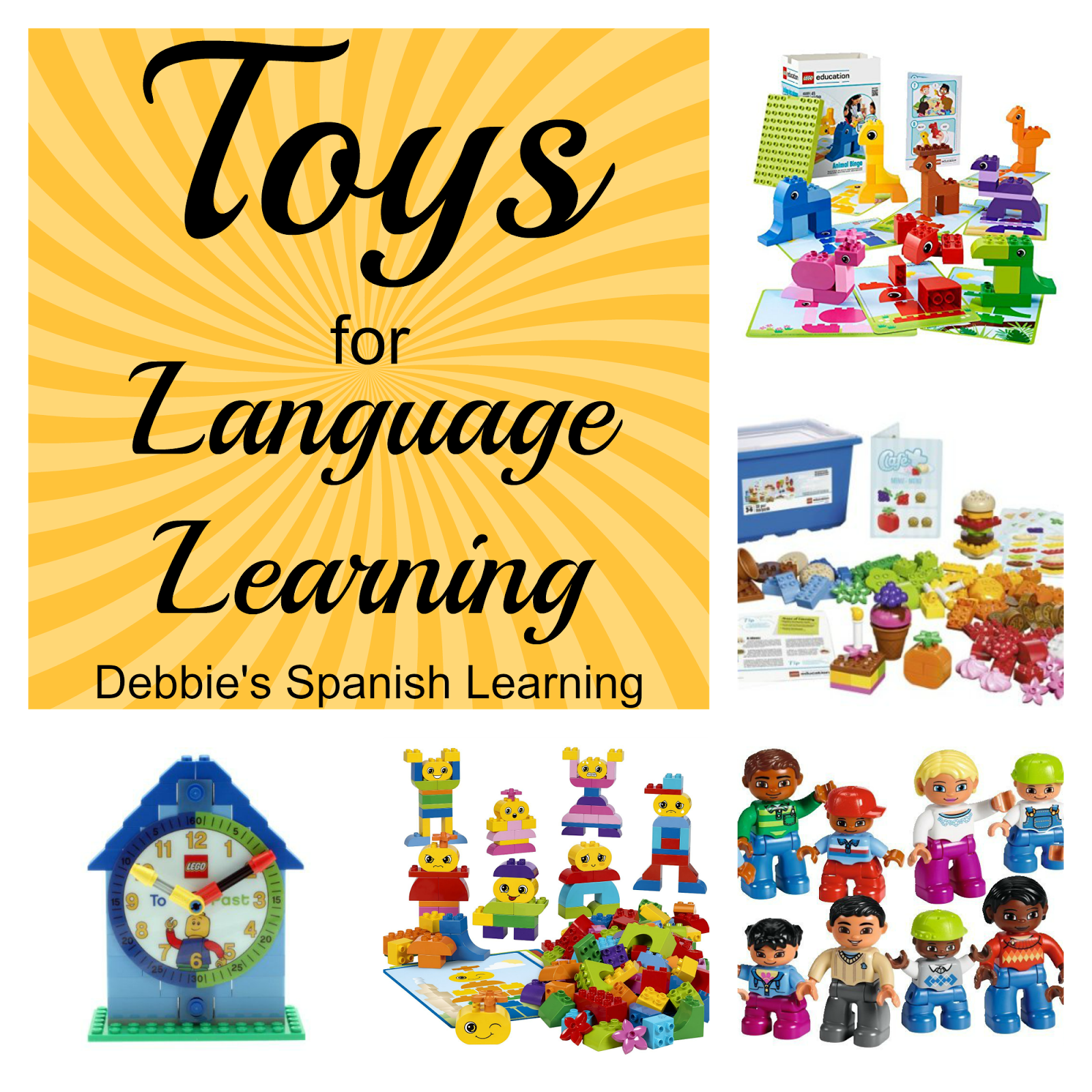
Toys for Language Learning


Affiliate Links used.

For young kids (and even some older ones), there is incredible value in having items that they can manipulate as they learn. My students eyes light up when I bring out any type of item that is toy-like to help them acquire Spanish. That's why this list of building sets could be incredibly valuable when you are teaching another language to kids.

These LEGO® sets would work really well if you are teaching young kids a foreign language...

The first one that caught my eye was the Build Me Emotions set. For years I have struggled to come up with ideas for teaching emotions so I am always on the lookout for new ideas. I see so much potential for this set like...

  • Telling students "Edifica triste" or "Edifica contento" then having kids build a character with that emotion.
  • Calling out an action in the target language and having them make a person with an appropriate emotion on its face. For example, the teacher says "Yo como el chocolate" and a happy person is built.
  • Describing a person (what they are wearing) and what they are doing then having kids make that person with the correct colored clothing and a facial expression for the action.


The Animal Bingo set is a like a bingo game in which kids pick a building card that allows them to create an animal as they collect the pieces for it. With this game, there is the opportunity to learn animal names, colors, and shapes.


The World People Set are great props for physical description of people and clothing. The vocabulary for family members would work well with these also. I would use this set by displaying all the figures and then describing in Spanish one of the people to see if my students can guess who I am talking about. Students can also describe the people in the target language. Another idea is to categorize the people into groups by calling out a characteristic like "pelo moreno" or "lleva azul" and have your students separate out those that fit into that category.


Community Minifigures - a great set for discussing occupations and descriptions of people.


Time Teacher with Constructible Clock- A clock that kids can build and that you can use with them to teach them to tell time!


Family and House Kit- Build this house and then there are opportunities to talk about the rooms of the house and what they contain. This set would be great to work with prepositions. Students could describe where things are located in the target language or the teacher could tell students where to put certain items.


This Food Set has a plethora of pieces so that kids can "build" different foods. This is definitely on my wish list as I know my younger students would adore it! There are opportunities to discuss the colors of the foods, learn new food words, and even do categories of foods (like fruits, veggies, meats, etc.)

LEGO®is a trademark of the LEGO Group of companies which does not sponsor, authorize or endorse this site.


Thursday, April 7, 2016

¡Caramba! Game

{Affiliate links used.}

I am closing out the school year with my Spanish lessons and wanted a way to review the vocabulary we have been working on. I came across on Pinterest a post about Kaboom! It was created for elementary classrooms, but I thought it would be perfect for language learners also! So here is how you go about it:

First of all you will need...

Jumbo Craft Sticks
Sharpie Markers
Cups (Not see through)

Since I work with a lot of different levels of students I had several categories of vocabulary I wanted to use like house items, the alphabet, clothes, opposites, etc. I decided to color-code the sticks  on one end. This helps with two things. Kids will know how to put them in the cup with the colored part sticking out. This allows me to  select which sets of vocabulary to use with certain sets of students. For example, I know that the orange sticks are emotions and the pink sticks are foods. {See the final set of pictures for the list I made for myself.}


After you color the tips, you write one word towards the other end of the stick. I tend to use about 15 sticks for a vocabulary-themed set. Three of those sticks will have the word "Caramba" written on them. The rest will have vocabulary words you want kids to review.


To play the game you put one set (or maybe two or three if you have more advanced students) in a cup with the colored tips up. Students take turns pulling a stick out of the cup and giving the translation of the word. They keep the stick if they can say what it means in English. Otherwise, they put it back in the cup if they don't know. If they pull a "Caramba" stick they have to put back ALL their sticks! I time the game for about three minutes. The student with the most sticks at the end wins!

This is a fun way to review vocabulary which at times can be tedious!


Sunday, January 17, 2016

Activities with Children's Books

{Affiliate Links Used}

If you have read my blog for any amount of time you know that I LOVE children's literature. I use it every day with my elementary students when I teach. Throughout my website I have several posts on how to take a book, read it to your students, and then do learning activities related to the story. Here is a list of what is currently available.

La Oruga Hambrienta is the book I use with young kids to introduce the days of the week. Here is a free printable activity to do with the book.

Si Quieres Ver Una Ballena is a sweet book with a boy that gives advice on how to see a whale. I have read this book to my students and then done this drawing activity with them.

Pinta Ratones can be used to introduce simple color theory to kids.

Here is a more advanced book with another color mixing activity.

Here's a great book to review prepositions and food vocabulary. A simple drawing activity is included. 

Oliver Jeffers' book, Arriba y Abajo, has opportunities to teach new vocabulary.


This sweet book about taking the moon for a walk is a great way to review the names of animals.

La Casa Adormecida allows you to review prepositions with young kids.

Atrapados is another awesome book by Oliver Jeffers. At the end of this post is an activity to review the vocabulary introduced in the book.

Se Venden Gorras has several learning opportunities with colors, patterns, and sorting.

To review numbers 1-20, use Un Alce, Veinte Ratones


Friday, January 8, 2016

Using Art in Language Learning


{Affiliate links used}

This following post has gotten a ton of traffic on my site. I am sharing it again along with some added resources and ideas...

As a language teacher, any time you can mix culture with language skills you up the amount of learning in your lessons. Last year with one of my most advanced students I started printing off interesting pictures for us to discuss in Spanish. It then occurred to me that we could do the same activity with the great works from various Spanish/Hispanic artists. Not only will my students get exposed to beautiful artwork, but they will also be able to practice their speaking skills.

In order to set up this activity you need a set of questions you can use with any painting and copies of the art itself.  Below you will find a free printable in Spanish of questions you can ask your students in order to get them talking about different paintings. As far as collecting the art you want to use here are several options:
  • You can also use art books to show pictures. 
  • You can print them from the web. Here is my pinterest board on teaching art and Spanish. It contains lots of paintings, and I plan on adding more. 
Here is a list of artists/paintings I am planning on using:

  • Diego Velázquez {Las Meninas/Tres Músicos}
  • Fernando Botero {La Menina,/Terremoto en Popayan}
  • Alejandro Xul Solar {Cuidá y Abismos,/Vuell Villa}
  • Joan Miró {La Finca,/Caballo, Pipa y Flor Roja}
  • Pablo Picasso {El Guitarrista Viejo/La Sopa}
  • Diego Rivera {Cargador de Flores/Zapata}
  • Oscar Tintaya {More modern Bolivian artist with typical scenes of that area}
  • Salvador Dalí {La Persistencia de la Memoria}
  • Raúl Soldi {Sarita}
  • Joaquín Sorolla y Bastida 

Here is the free printable with questions you can use to discuss the paintings.

Another item that I have found helpful is to discuss color theory with my advanced students. This page has a great color wheel in Spanish to help you do that!

Here is a Diego Rivera painting lesson. How cool would it be to do this in Spanish with your students?


Here are some resources for younger kids:


¿Quién fue Pablo Picasso?


Xul Solar. Arte para chicos -I haven't bought one of these yet, but the title intrigues me. So many times you have to screen art that is appropriate for children. I am wondering if these would do that for you.

Antonio Berni. Arte para chicos

Frida- A biography for younger kids.

Diego- A bilingual biography for kids