Showing posts with label House. Show all posts

Friday, October 20, 2017

Hide-N-Seek Vocabulary Game (for Second Language Learning)

{Affiliate Links Used}

I struggle sometimes on how to get my youngest students to use the language especially when they are in the first few months of exposure to Spanish. The first problem is that with lower elementary-age students their attention span is very short, and when you add the fact that they have limited vocabulary at the beginning it can be challenging to find activities to get them talking in the target language. This week though I came across an activity that really worked! Not only does this activity require that they speak in Spanish, but it incorporates repetition of the vocabulary in a way that keeps them motivated. Here's how it works...


I create picture cards with the vocabulary on them we are working on. The ones you see here are for the weather, but the cards could be any group of vocabulary as long as you can use pictures: clothing, rooms in a house, places in a city, foods, etc. I laminate the cards (VERY IMPORTANT) so that I can use the dot stickers on the back of them. If the cards aren't laminated then you won't be able to get the sticker off as easily.  I lay out the cards face up on the table. If you have a large group of students you can make bigger cards and hang them up. Then I ask my students in the target language to turn around (away from the cards) and close their eyes (young ones are expert "peekers" so I have them do both actions). I then take a colored dot (See these here as they are easy to remove.) and stick it to the back of one of the cards. Then all my students can turn around and open their eyes. They take turns asking in the target language about a card to see if the dot is behind it.


So for example, if we are working on weather words they would ask, "¿Está nublado?" or "¿Hace viento?". I then reveal the underneath of the card to show them whether the dot is there or not. After I have hidden the dot a few times, I let some of my students do the hiding. If you have a large group, you may not be able to let everyone hide each time you play the game. So you may want to keep track of who has hidden the dot so that next time other students can do it. My students absolutely LOVE hiding the sticker and being in charge of answering the questions and revealing the backside of the cards. Another variation I do (normally at the end of the activity) is for me to "hide" the dot one more time. However, this last time around, I don't actually hide the dot on one of the cards. I put it some place else out of sight. This forces the students to ask about ALL the cards and review all the vocabulary. When the last card is revealed there may be some surprised looks! 😊

While I have used this with great success with elementary-age kids, it can be used as a quick review for older students (like in high school). I love how it requires students to use the language and how they get to hear the words/phrases over and over again. The other added benefit? If a child has the task of hiding the dot, he or she then also has to practice finding which card the other student is asking about. There's plenty of repetition and review without it being boring!


Saturday, September 2, 2017

Word Pictures for Vocabulary Review


 {Affiliate Links Used.}

Want a simple activity that incorporates creativity with vocabulary learning? How about trying word pictures with your students? Pictures are drawn entirely with words. For each part of the picture, students write the word for that part over and over again to form the shape of the item. For example, if you are drawing a dress then you would write the word "dress" to create the shape of the dress.


The best way to start these pictures is with a pencil. Have your students lightly outline their drawing. Then using fine tip pens (I used these.), have your students write the word over the pencil lines. They should pick words that correspond to each part of the picture. There is a little bit of poetic license, for the face in the picture I could use cara (face), cabeza (head), or chica (girl). When they are done they can erase the pencil lines. Let your students be creative!


They will also need to decide how much they will break down the picture with vocabulary words. I had the option on the picture below to write the words "trunk" and "leaves" for the tree, but just opted to write "tree" in Spanish instead.


This simple activity is a great way to reinforce the vocabulary your students are learning. You can do pictures for all different kinds of sets of words: weather, body parts, clothing, parts of a house, furniture, cities, foods, etc. Have fun being creative!!


Thursday, June 22, 2017

Spanish Camp for Kids {Day 4}

{Affiliate Links Used}

I had the privilege of living in Buenos Aires, Argentina for awhile to improve my Spanish. One of the interesting places I visited was the neighborhood of La Boca with its brightly painted houses. So for the fourth day of my Spanish camp we are going to focus on houses and the vocabulary surrounding them (door, window, up, down, outside, inside) and then recreate some of the typical houses in La Boca.


Today I have decided to rely heavily on die cuts. I made six houses each in a different color. I also made die cuts of different weather symbols. So to review weather, house, and color vocabulary I will give students instructions in Spanish and see if they can create the scene I describe. For example...

Llueve sobre la casa roja.
Nieva sobre la casa verde.


I am also going to take this opportunity to review animals with the die cut houses. I found some animals that were smaller than the houses. I will lay out all the different colored houses and then hide one of the animals underneath one of the houses. Students will need to ask me in the target language if the animal is behind the blue house or the yellow house, etc. 


Another activity we will do is to draw in the details of houses following my instructions in Spanish. See this post for more information. And this post for the printable of houses you can use.

One of our active games today will be using the colored cups I bought for the week. With them we will play "Arriba/Abajo". Take several cups (maybe twice as many cups as you have students) and place half of them right side up (arriba) and half of them upside down (abajo) on the lawn or large play area. Divide your group into two teams one that is "arriba" and one that is "abajo". Tell them to start...the object of the game is to change the cups to fit what team you are on. If you are on the "arriba" team then you need to run around putting all the cups right side up. If you are on the "abajo" team then you want them all upside down. Give them one minute to play. The team with the most cups in their position wins.

Our craft will be to re-create the houses of La Boca, Argentina. Here are the instructions for the project with a little background information on La Boca. 


You will need a paper crimper for this project to give the right look to the sides of the buildings. Here is a link to get an idea of what to look for...


For our reading today we will dive into the following books:


Harold y el Lapiz Color Morado
Ruidos en la Casa- Cute book of a puppy who is scared being home alone
La Casa Adormecida
El Pastel Esta Tan Arriba
Oso en Casa

To see the rest of my plans for the other days of camp, click HERE!!


Saturday, June 17, 2017

Spanish Camp Ideas

{Affiliate Links Used.}

This summer I am branching out and doing mini-camps to teach kids Spanish. The camps will be for elementary-age kids relatively new to the language and last one week. Mine will be two hours a day (although my ideas could totally be stretched to three hours a day).  Over the next week or so I will share with you my ideas...what I will teach each day, the games we will play, and the cultural crafts we will do. I have to admit that I have relied heavily on Pinterest for great ideas for games and crafts. The bulk of the work has been setting up the structure of what I am going to teach. So join me over the next week or so as I give you details of what you can do if you decide to teach a Spanish camp yourself. We'll talk supplies, activities, games, culture, and crafts. {Like these great bilingual cookies to hand out during the week.}

So join me! And I would love to hear your ideas, too! You can eventually find all the posts HERE.

Thursday, November 10, 2016

Spanish File Folder Guessing Game

{Affiliate links used.}

A few years back, I found an old game at a garage sale in which you have to guess where the family members are located in your opponent's house. It is a GREAT game for talking about the rooms in the house, using the verb "estar", and discussing family members. However, I only had one game for two players so I never could use the game in groups. So I decided to make my own! While this project is a lot of prep, the work is worth it as your students will spend about 10-20 minutes completely in the target language, and the games can be used over and over again. So let's take a look at how the game is played...

{See the photos as a reference.}
Each person has a game board/folder with two houses on it. One house is where the player arranges family members in certain rooms. The other house is for recording where the family members are in his or her opponent's house. To set up, each player places all eight family members (grandpa, grandma, dad, mom, brother, sister, dog, and cat) in one of the houses. They lay the other set of family members off to the side. Then the players take turns asking yes/no questions about each other's houses like...

Is the dad upstairs?
Is the dog downstairs?
Is the mom in the bathroom?

They keep going back and forth with questions until all of the second set of family members are placed correctly in the second house. The first player to figure out where every family member is in his/her opponent's house wins.

To play the game, each person needs a playing board that has two pictures of the same house, two sets of family members, and I also include a card that helps my students with vocabulary and forming the questions (photo #6).

In order to make the boards you will need the following items to make this game:
To assemble the boards:
  • Print out the houses (two houses per game folder). Make sure you print a size that will fit in a file folder after it is laminated. Laminate them.
  • Print out the family members (two families per game folder) and laminate them. Make sure that the family members are printed out to a size in which they can fit in the rooms of the house.
  • Adhere two houses onto the inside of a folder (See the picture below). I used glue dots or you could use liquid glue. Make sure you DON'T center the houses but rather put them off to the side so that you can put the envelope of playing pieces (photo #5) and the vocabulary list (Here's the list) (photo #6) in the folder.
  • Use glue dots to adhere the envelope to one of the sides of the file folder.
  • Print out a vocabulary list and/or a list of possible questions to use during the game. Laminate it and put it on the other side of the folder. 
  • Adhere the clear part of the Velcro dots to the rooms in the house with the E-6000 glue. I put only one or two dots in each room. You want as many dots in the house as family members. I used 8 people (grandpa, grandma, dad, mom, brother, sister, dog, cat). You can kind of see the dots in photo #4.
  • Adhere the white side of a Velcro dot to each family member using the E-6000 glue. 
  • Let dry.
  • Play the game!
NOTE: The Velcro dots already have an adhesive on them, but I used the E-6000 glue to make the game extra durable.

I have my students use the top house to place their family members while the bottom house is where they place the people once they figure out where they are located on their opponent's board. The file folder makes an excellent "shield" so that the opponent can't see where the family members are placed.

I have a feeling that the possibilities could be expanded for this type of speaking game. For example, you could have pictures of an empty fridge and have students converse until the fridge is full with the correct foods. Or you could have a simple street map in which students have to guess where the different buildings are in their partners' city. Another idea is to have faces in the file folders and players have to guess what the face of their opponent looks like (hair and eye color, hair length, facial hair, etc.). So many ideas you could use to help your students work with the vocabulary they are learning!


Saturday, April 23, 2016

Silly Sentences in Spanish

{Affiliate links used.}

I love using flashcards to help kids review vocabulary, but let's face it, review with flashcards is rather boring. So when I can, I use flashcards as a basis for creating crazy sentences. Most of my flashcards are stored in categories. For example, all modes of transportation are together or all items in a house are in another pile. {NOTE: I make flashcards with the pictures from these books: Basic Vocabulary Builder and Practical Vocabulary Builder.}


I pick about three categories of vocabulary cards and lay the piles face down. For example, I could use professions, places in a city, and modes of transportation. A student picks up the top card of each pile and then says a sentence based on the three pictures. For example...

El mecánico va al cine en la moto.

The next student then turns over the next set of cards to create a new sentence. Many of the sentences will be "crazy"...like "The doctors go to the supermarket in a helicopter."

There are tons of card combinations you can use to create sentences. Here are just a few ideas with the cards you would use and an example sentence:

  • Subject pronouns~Verb~Place  {Yo bailo en el banco.}
  • Family Members~Food~Colors {La hermana come las fresas verdes.}
  • Household Items~Rooms in a House {La cama está en la sala.}
  • Clothing~Colors~Seasons  {Uso la camisa blanca en el verano.}
  • Animals~Preposition~Items in a House {El mono está a la derecha de la mesa.}

Don't want to make your own cards? Here are cards that would go well with this activity...


Photo Cards {Already separated into 16 categories}

Photo action cards


Noun Cards {Things Around the Home}


Tuesday, April 19, 2016

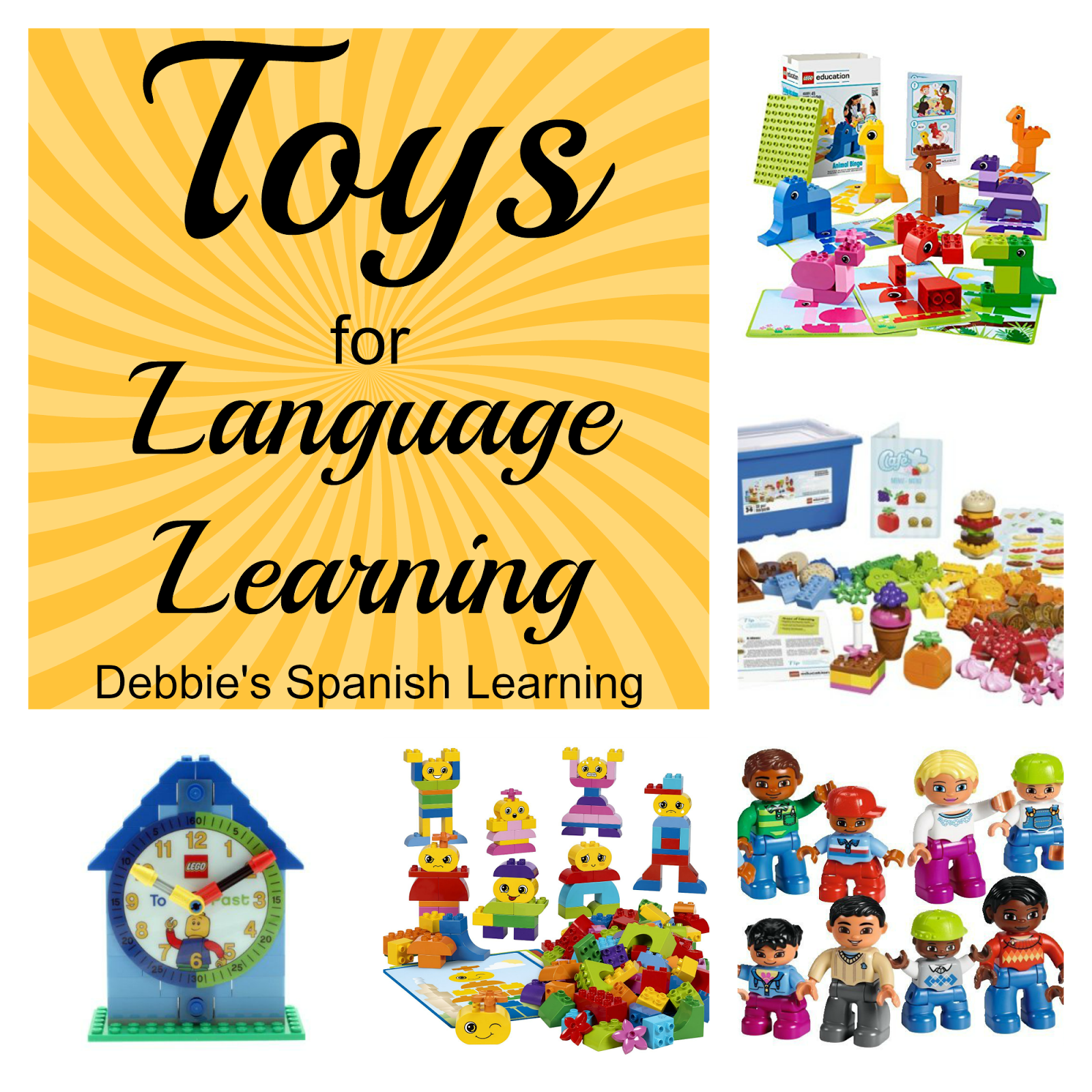
Toys for Language Learning


Affiliate Links used.

For young kids (and even some older ones), there is incredible value in having items that they can manipulate as they learn. My students eyes light up when I bring out any type of item that is toy-like to help them acquire Spanish. That's why this list of building sets could be incredibly valuable when you are teaching another language to kids.

These LEGO® sets would work really well if you are teaching young kids a foreign language...

The first one that caught my eye was the Build Me Emotions set. For years I have struggled to come up with ideas for teaching emotions so I am always on the lookout for new ideas. I see so much potential for this set like...

  • Telling students "Edifica triste" or "Edifica contento" then having kids build a character with that emotion.
  • Calling out an action in the target language and having them make a person with an appropriate emotion on its face. For example, the teacher says "Yo como el chocolate" and a happy person is built.
  • Describing a person (what they are wearing) and what they are doing then having kids make that person with the correct colored clothing and a facial expression for the action.


The Animal Bingo set is a like a bingo game in which kids pick a building card that allows them to create an animal as they collect the pieces for it. With this game, there is the opportunity to learn animal names, colors, and shapes.


The World People Set are great props for physical description of people and clothing. The vocabulary for family members would work well with these also. I would use this set by displaying all the figures and then describing in Spanish one of the people to see if my students can guess who I am talking about. Students can also describe the people in the target language. Another idea is to categorize the people into groups by calling out a characteristic like "pelo moreno" or "lleva azul" and have your students separate out those that fit into that category.


Community Minifigures - a great set for discussing occupations and descriptions of people.


Time Teacher with Constructible Clock- A clock that kids can build and that you can use with them to teach them to tell time!


Family and House Kit- Build this house and then there are opportunities to talk about the rooms of the house and what they contain. This set would be great to work with prepositions. Students could describe where things are located in the target language or the teacher could tell students where to put certain items.


This Food Set has a plethora of pieces so that kids can "build" different foods. This is definitely on my wish list as I know my younger students would adore it! There are opportunities to discuss the colors of the foods, learn new food words, and even do categories of foods (like fruits, veggies, meats, etc.)

LEGO®is a trademark of the LEGO Group of companies which does not sponsor, authorize or endorse this site.


Thursday, April 7, 2016

¡Caramba! Game

{Affiliate links used.}

I am closing out the school year with my Spanish lessons and wanted a way to review the vocabulary we have been working on. I came across on Pinterest a post about Kaboom! It was created for elementary classrooms, but I thought it would be perfect for language learners also! So here is how you go about it:

First of all you will need...

Jumbo Craft Sticks
Sharpie Markers
Cups (Not see through)

Since I work with a lot of different levels of students I had several categories of vocabulary I wanted to use like house items, the alphabet, clothes, opposites, etc. I decided to color-code the sticks  on one end. This helps with two things. Kids will know how to put them in the cup with the colored part sticking out. This allows me to  select which sets of vocabulary to use with certain sets of students. For example, I know that the orange sticks are emotions and the pink sticks are foods. {See the final set of pictures for the list I made for myself.}


After you color the tips, you write one word towards the other end of the stick. I tend to use about 15 sticks for a vocabulary-themed set. Three of those sticks will have the word "Caramba" written on them. The rest will have vocabulary words you want kids to review.


To play the game you put one set (or maybe two or three if you have more advanced students) in a cup with the colored tips up. Students take turns pulling a stick out of the cup and giving the translation of the word. They keep the stick if they can say what it means in English. Otherwise, they put it back in the cup if they don't know. If they pull a "Caramba" stick they have to put back ALL their sticks! I time the game for about three minutes. The student with the most sticks at the end wins!

This is a fun way to review vocabulary which at times can be tedious!


Wednesday, September 23, 2015

Listening and Drawing Activities {Free Printables}


I recently came across some wonderful drawing activities on Spanish Playground {By the way, if you are not familiar with this site and you teach Spanish to kids you REALLY need to check it out! It is an awesome resource!}. The site has a drawing activity with stick figures and one with houses. Instead of having my students read the descriptions to themselves, I read them out loud to see if they understood and then they did the drawings. I even branched out with these and incorporated different topics...

For the houses you can do the following topics:

house description {door, windows, color}
weather
seasons
items inside and outside of the house {Great for reviewing "adentro" and "afuera"}
items above and below in the house {Great for reviewing "arriba" and "abajo"}
time {Have the students draw a clock above the house and fill in the time}


For the stick figures you can do the following topics:

clothing/colors
emotions
weather
seasons
action words {For example, you can say "La chica escribe." and have them draw a pencil and paper near the girl.}

After I modeled several examples and they drew I then made the students do their own descriptions out loud. If you have a group of kids you can pick one child to describe a house or person and have the others students draw it. If you are just working with one student or your own child, have him or her describe and YOU do the drawing. Because I had modeled how to describe a house or person several times before handing over the reins to them, my students were very creative in their descriptions! They even incorporated more vocabulary than I did!

My students so enjoyed these activities that I decided to branch out a bit and make a few more. The first template can be used with places in a city or rooms in the house. The little circle up in the corner can be for the time of day or used as a face to draw the emotion of the person in that place.


The second template is a table setting. With this page you can describe what is on the plate and also use prepositions to have your students draw the silverware, cups, bowls, etc. Below you will find the printables for both of these pages along with some descriptions already typed up for you to get you started. For those of you that teach other languages feel free to use the templates and create your own descriptions in the target language you are teaching.


Here are the free printables!

Template for Places Drawings
Instructions for Places Drawings
Template for Food Drawings
Instructions for Food Drawings

Tuesday, January 20, 2015

Ruidos en la Casa


This post is part of a series, 31 Days of Spanish Books for Kids. Please click HERE for the complete list of posts. {Each of these posts contain affiliate links. Thanks for supporting this blog!}


Ruidos en la casa: Un misterio is a cute story about a dog that is afraid of the noises he is hearing in the house. The poor puppy goes through all kinds of scenarios on what could be causing the noises. In the end, he gets a delightful surprise that isn't scary at all!

My students are drawn to this book because of the facial expressions of the dog. In the process of reading it, they are exposed to a plethora of house vocabulary:

la puerta
la ventana
el piso
el reloj
el calentador
el refrigerador
el techo
el garaje
el corredor
la pared

This book could also be added to a unit on the five senses since it surrounds the different noises that the dog is hearing. This also might be the time to talk about onomatopoeia. Señor Pancho Had a Rancho explores the different sounds on a farm in both Spanish and English and would be a great addition to talking about onomatopoeia.