Showing posts with label Prepositions. Show all posts

Tuesday, April 11, 2017

Seasons Activities in Spanish {Free Printable}


{Affiliate Links Used.}

Seasons are hard words to remember in another language. Over the twenty years I have been teaching I find that even though it is only four vocabulary words they can be forgotten quickly. So I was really pleased to come across a book in Spanish that beautifully illustrates the changing of the seasons...


Las 4 Estaciones Desde el Gran Arbol shows the progression of the seasons with a tree in the forest. The animals around it come and go as the year passes. The weather changes. The plants grow and become dormant or die. And during the whole time there is an owl in the tree watching the events around him. The book has cut outs that allows you to see the animals in the tree. There are several activities that you can do as you read the book and then afterwards. Let's take a look...


For my students that can write I have them re-create the four seasons with pictures and words in Spanish. (You can download this page here.)  They can draw in the way a tree would look for each season and then label the squares with the correct word. I also have them add color and weather words related to each season in the appropriate square. Another set of vocabulary that could be added are the months in the appropriate season, but be careful with this! What if you are in the southern hemisphere? This would be a great time to discuss how summer happens in December, January, and February in South America (like in Argentina and Chile).

During the reading of the book you can point out all the animals that are throughout the story. One of the reasons that I love this book is because there are so many animals and they reoccur several times on the different pages. For younger kids, I call out the name of an animal and they can count them. For older kids this is a great time to play Spot It! (the animal version) to review the names of animals. (See here how I use Spot It! as a teaching tool AND game at the same time.)

For more advanced students that know their prepositions, you can do a drawing activity with them. Students start out with a blank piece of paper and you describe a scene with a tree in Spanish that they have to draw. Here's a sample description that could be drawn:

Hay un árbol grande con un sol brillante en el cielo. En el árbol hay dos búhos y tres ardillas. Debajo del árbol, hay una familia de zorros. Un zorro persigue una mariposa. El árbol tiene manzanas en las ramas y un nido lleno de huevos.

Finally, here are some resources that are great for working with the seasons...


Y De Pronto Es Primavera-A sweet story about waiting for spring to come.

Froggy Se Viste- Frogs are not supposed to go out in the snow and play! A story filled with winter words (especially clothing).

Un Recorrido Por Las Estaciones- Scenes from all the seasons with an emphasis on each month.

A simple puzzle for younger kids.  Actually, this concept for be great for kids if you make flashcards. Can they put the objects in the right season?

Finally, I use this vocabulary sorting activity with older students. It's a great way to familiarize them with more words that they need to put into one of the four seasons.


Wednesday, February 1, 2017

Teaching Ideas for Spanish in the Spring

(Affiliate Links Used.)

Here are several resources you can use during the Spring months as you teach Spanish...books, learning activities, and so much more! Happy Spring!


Spring Books in Spanish- Here's a list of great books to read during the spring months.


El Nabo Gigante spans not only the spring, but into the fall harvest time. This post has learning activities to go along with the book.


Arriba, Abajo, y Alrededor is a great gardening book in which you can focus on prepositions and words for vegetables.


Y De Pronto es Primavera- A sweet story of how spring can surprise us!


Plant Unit- I have created a plant unit that you could use during the spring months. Lots of vocabulary related to plant parts and types of veggies in this post!


Easter Resources- Here you can find some books, "emotion eggs", and other activities to do close to Easter.


Compound Words with Eggs- Last year my younger students worked with compound words in Spanish. We used Easter eggs to review their vocabulary!

I would love to hear what activities you do with your Spanish students during the spring months!


Monday, July 25, 2016

¿Dónde Está la Oveja Verde?


{Affiliate links used.}

Today let's take a look at ¿Dónde Está la Oveja Verde?, a cute book in search of a little green sheep. This book is great for younger kids that are bilingual or learning Spanish. With it you can teach and/or review colors, prepositions, and opposites. Let's take a look...

Since several of the colors are mentioned in the book, this would be a great time to teach colors. Here is a free pattern to use to make different colored sheep. This would be great to use in conjunction with prepositions in the book (abajo, arriba, lejos, cerca).  In Spanish, you can ask your students to position the sheep according to your instructions. For example, "Pongan la oveja roja cerca de la amarilla."

Another aspect of the book is to focus on opposite words. In the book there are the following opposites: flaca, gorda, abajo, arriba, asustada, valiente, cerca, lejos. I love this traditional song that works with opposites. I have done it with my students in the past and they have loved the challenge of it! You start out easy having them say the opposite of what you say by making the list of three words the same (blanco, blanco, blanco), but then make it more difficult by mixing up the words. Here is a video by Luis Pescetti demonstrating how it is done:


Here are the words to the song:

Yo conozco un juego / I know a game
que se juega así. / that you play like this.
Cuando yo digo blanco, / When I say white,
Uds. dicen negro. /you say black.
Cuando yo digo negro, / When I say black,
Uds. dicen blanco. /you say white.
Este juego va a empezar; / This game is going to start;
no se vayan a equivocar. / don’t make a mistake.
Blanco, blanco, blanco / White, white, white (leader)
Negro, negro, negro / Black, black, black (group)
Blanco, negro, blanco / White, black, white (leader)
Negro, blanco, negro / Black, white, black (group)


Another option is to do a drawing activity with sheep by describing the sheep using the vocabulary in the book. Here are some ideas of what you can say and have your students draw...

La oveja azul se baña.
La oveja flaca va hacia arriba.
La oveja anaranjada juega en las olas.
La oveja asustada está lejos.
La oveja blanca está en la luna.
La oveja negra va en coche.
Esta oveja toma el sol.
La oveja valiente va abajo.
La oveja morada baila bajo la lluvia.

La oveja verde está dormida.

Finally, I know you have heard of counting sheep so why not get your kids counting...even skip counting! Here is a link to some low-cost printables to do just that.

If you are looking for more learning activities to go along with Spanish children's book, check out this post. 


Monday, June 27, 2016

Se Venden Gorras

{Affiliate links used.}

Se Venden Gorras is a classic book that you can use to reinforce colors, actions, and prepositions in Spanish. Let's take a quick look at what you can do with this book when teaching Spanish...

A fun activity to do with this book is TPR (Total Physical Response). There are several actions within the story that you can ask your students to perform through giving commands in Spanish. Here is a list of the actions you can use...

Dormirse, despertarse, tocarse la cabeza, buscar a la derecha (a la izquierda), buscar a espaldas, levantar la vista, señalar con el dedo, apretar los puños, dar puntapiés, quitarse la gorra, tirarla al suelo, arrodillarse

With these actions, you can also play Simon says.


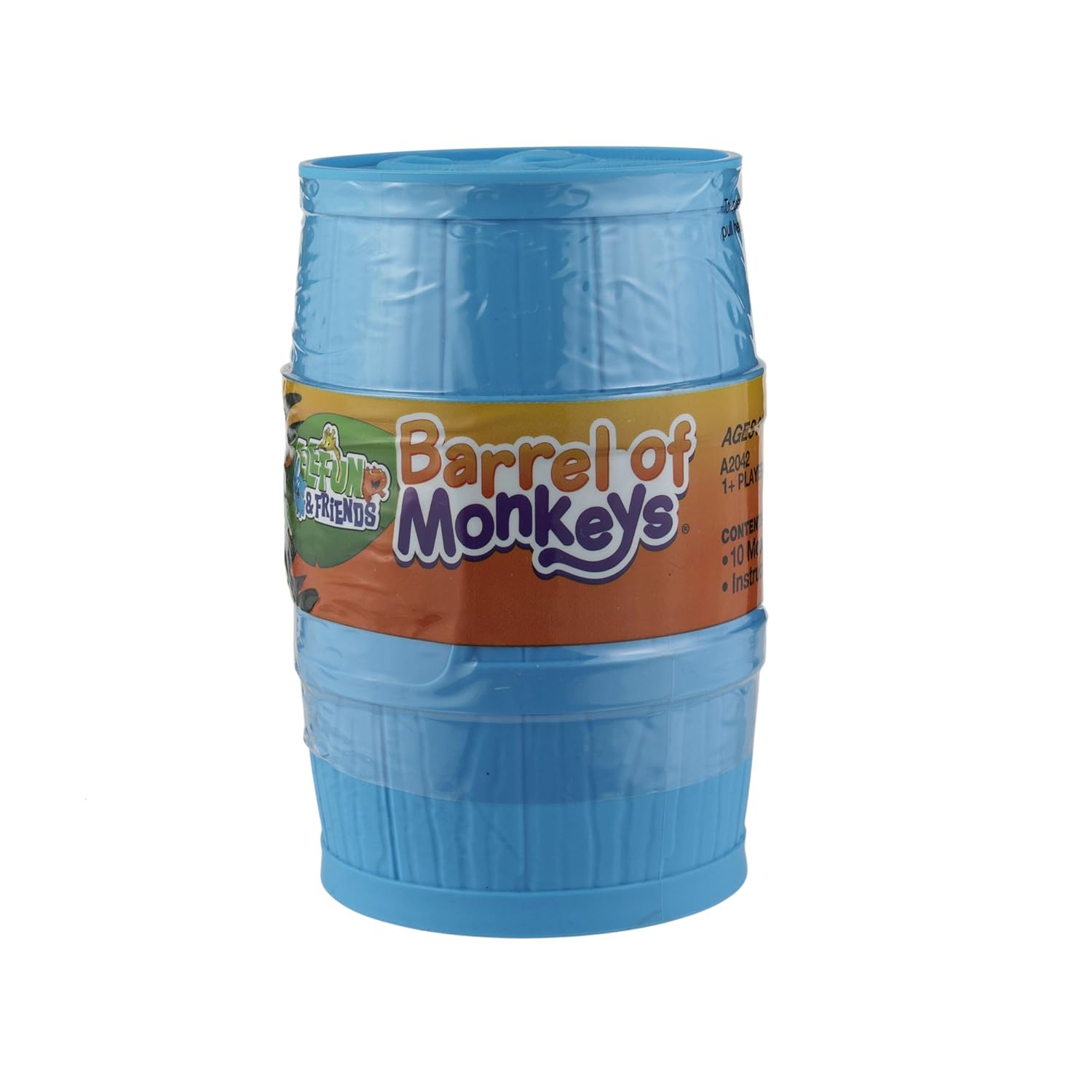
Remember the old game, Barrel of Monkeys? This would be a great time to play that game and practice counting in Spanish. 

This is a great printable you can do with your students. Give them instructions in Spanish on how many blue caps, red caps, etc. they need. Then also tell them in Spanish the order of the caps (you can make up a new order that's different from the book) that go on the peddler's head. Here are some more printables that are similar in which you can do a sequencing activity in Spanish.

Here are some free printables for the book. Yes, they are in English, but be creative and think of ways you could use them in Spanish. 

Here's such a cool idea...have your students recreate the story with actual manipulatives! This idea comes from Magical Movement Company. You can find it here.

CLICK HERE for more book activities.


Tuesday, April 19, 2016

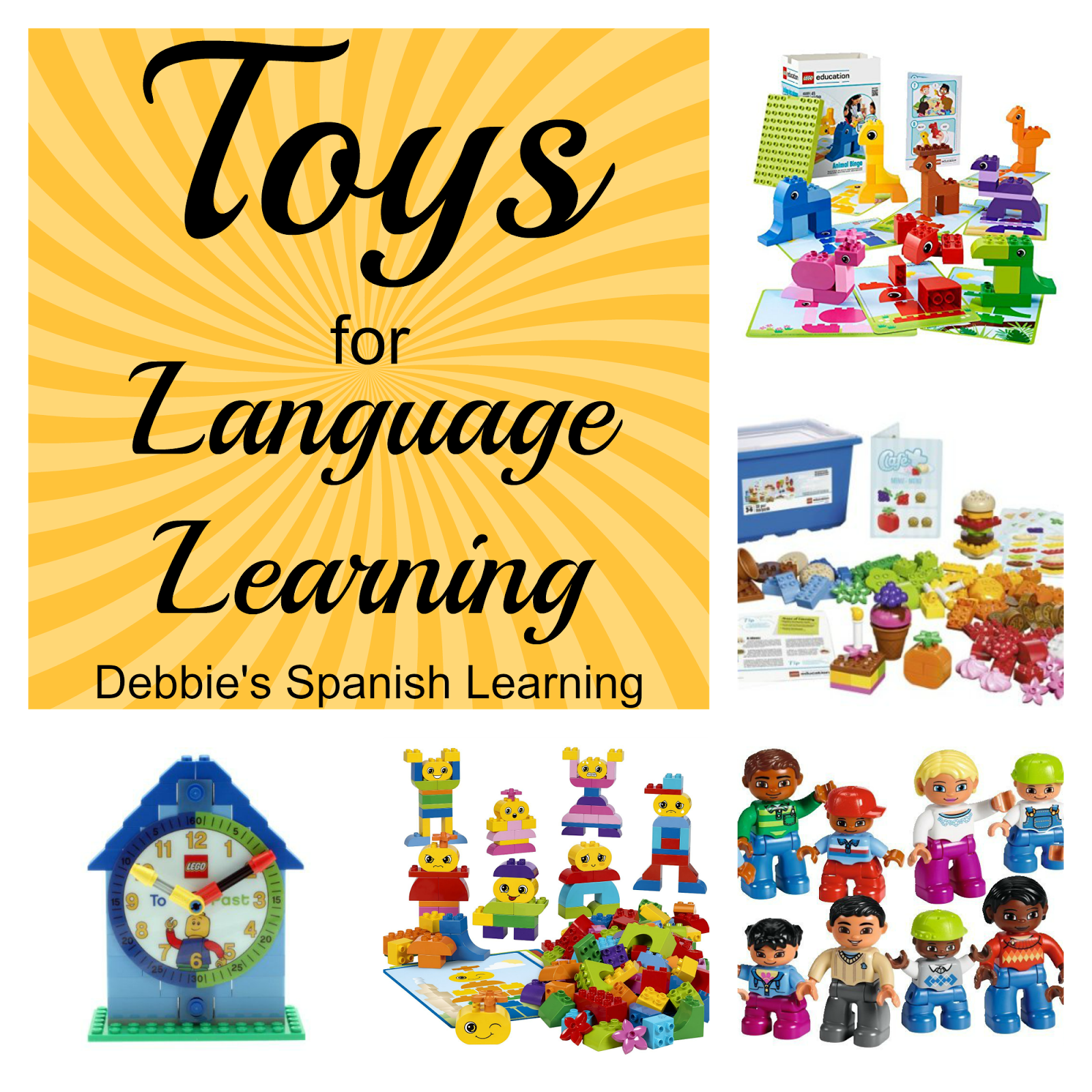
Toys for Language Learning


Affiliate Links used.

For young kids (and even some older ones), there is incredible value in having items that they can manipulate as they learn. My students eyes light up when I bring out any type of item that is toy-like to help them acquire Spanish. That's why this list of building sets could be incredibly valuable when you are teaching another language to kids.

These LEGO® sets would work really well if you are teaching young kids a foreign language...

The first one that caught my eye was the Build Me Emotions set. For years I have struggled to come up with ideas for teaching emotions so I am always on the lookout for new ideas. I see so much potential for this set like...

  • Telling students "Edifica triste" or "Edifica contento" then having kids build a character with that emotion.
  • Calling out an action in the target language and having them make a person with an appropriate emotion on its face. For example, the teacher says "Yo como el chocolate" and a happy person is built.
  • Describing a person (what they are wearing) and what they are doing then having kids make that person with the correct colored clothing and a facial expression for the action.


The Animal Bingo set is a like a bingo game in which kids pick a building card that allows them to create an animal as they collect the pieces for it. With this game, there is the opportunity to learn animal names, colors, and shapes.


The World People Set are great props for physical description of people and clothing. The vocabulary for family members would work well with these also. I would use this set by displaying all the figures and then describing in Spanish one of the people to see if my students can guess who I am talking about. Students can also describe the people in the target language. Another idea is to categorize the people into groups by calling out a characteristic like "pelo moreno" or "lleva azul" and have your students separate out those that fit into that category.


Community Minifigures - a great set for discussing occupations and descriptions of people.


Time Teacher with Constructible Clock- A clock that kids can build and that you can use with them to teach them to tell time!


Family and House Kit- Build this house and then there are opportunities to talk about the rooms of the house and what they contain. This set would be great to work with prepositions. Students could describe where things are located in the target language or the teacher could tell students where to put certain items.


This Food Set has a plethora of pieces so that kids can "build" different foods. This is definitely on my wish list as I know my younger students would adore it! There are opportunities to discuss the colors of the foods, learn new food words, and even do categories of foods (like fruits, veggies, meats, etc.)

LEGO®is a trademark of the LEGO Group of companies which does not sponsor, authorize or endorse this site.


Monday, February 8, 2016

Harold and the Purple Crayon Activity in Spanish

{Affiliate links used.}

I love children's literature, and many of my students love to draw. There are several books out there that lend themselves well to drawing the scenes from the story after you read it to your students. I especially like the books in which I can incorporate prepositions for my students to review. Here is an example from the book, Si Quieres Ver una Ballena.

Harold y el Lapiz Color Morado  is another great book to use if you want your kids to practice or review prepositions. Basically, I read the book to them and then have them get a blank sheet of paper which we fold in half three times. This gives you eight "boxes". In each of the boxes, your kids will draw a sketch of what you say to them in Spanish. Here are some of the sentences I have my students draw, but you could definitely do your own based on the book.

La luna está sobre el camino.
Hay manzanas arriba en el árbol.
Hay un dragón debajo del árbol.
Harold está debajo del agua.
El alce está cerca de los pasteles.
El puercoespín está lejos de Harold.
Harold está encima de la montaña.
Hay una cesta debajo del globo.
El globo está enfrente de la casa.
La luna está afuera.
La ventana está alrededor de la luna.
La manta está encima de Harold.

El lápiz morado está en el suelo.

Have fun drawing with prepositions!

And by the way, if you have any great book recommendations for doing this type of activity I would love for you to leave them in the comments!

Sunday, January 17, 2016

Activities with Children's Books

{Affiliate Links Used}

If you have read my blog for any amount of time you know that I LOVE children's literature. I use it every day with my elementary students when I teach. Throughout my website I have several posts on how to take a book, read it to your students, and then do learning activities related to the story. Here is a list of what is currently available.

La Oruga Hambrienta is the book I use with young kids to introduce the days of the week. Here is a free printable activity to do with the book.

Si Quieres Ver Una Ballena is a sweet book with a boy that gives advice on how to see a whale. I have read this book to my students and then done this drawing activity with them.

Pinta Ratones can be used to introduce simple color theory to kids.

Here is a more advanced book with another color mixing activity.

Here's a great book to review prepositions and food vocabulary. A simple drawing activity is included. 

Oliver Jeffers' book, Arriba y Abajo, has opportunities to teach new vocabulary.


This sweet book about taking the moon for a walk is a great way to review the names of animals.

La Casa Adormecida allows you to review prepositions with young kids.

Atrapados is another awesome book by Oliver Jeffers. At the end of this post is an activity to review the vocabulary introduced in the book.

Se Venden Gorras has several learning opportunities with colors, patterns, and sorting.

To review numbers 1-20, use Un Alce, Veinte Ratones


Wednesday, September 23, 2015

Listening and Drawing Activities {Free Printables}


I recently came across some wonderful drawing activities on Spanish Playground {By the way, if you are not familiar with this site and you teach Spanish to kids you REALLY need to check it out! It is an awesome resource!}. The site has a drawing activity with stick figures and one with houses. Instead of having my students read the descriptions to themselves, I read them out loud to see if they understood and then they did the drawings. I even branched out with these and incorporated different topics...

For the houses you can do the following topics:

house description {door, windows, color}
weather
seasons
items inside and outside of the house {Great for reviewing "adentro" and "afuera"}
items above and below in the house {Great for reviewing "arriba" and "abajo"}
time {Have the students draw a clock above the house and fill in the time}


For the stick figures you can do the following topics:

clothing/colors
emotions
weather
seasons
action words {For example, you can say "La chica escribe." and have them draw a pencil and paper near the girl.}

After I modeled several examples and they drew I then made the students do their own descriptions out loud. If you have a group of kids you can pick one child to describe a house or person and have the others students draw it. If you are just working with one student or your own child, have him or her describe and YOU do the drawing. Because I had modeled how to describe a house or person several times before handing over the reins to them, my students were very creative in their descriptions! They even incorporated more vocabulary than I did!

My students so enjoyed these activities that I decided to branch out a bit and make a few more. The first template can be used with places in a city or rooms in the house. The little circle up in the corner can be for the time of day or used as a face to draw the emotion of the person in that place.


The second template is a table setting. With this page you can describe what is on the plate and also use prepositions to have your students draw the silverware, cups, bowls, etc. Below you will find the printables for both of these pages along with some descriptions already typed up for you to get you started. For those of you that teach other languages feel free to use the templates and create your own descriptions in the target language you are teaching.


Here are the free printables!

Template for Places Drawings
Instructions for Places Drawings
Template for Food Drawings
Instructions for Food Drawings

Wednesday, September 16, 2015

Si Quieres Ver Una Ballena {Book and Learning Activities}


{Affiliate links used.}

This fall I am working on getting an ocean unit study ready in Spanish for my students. While searching for ocean-themed books I came across Si quieres ver una ballena , a sweet book about a boy who gives advice on how to see a whale. Throughout the book he gives tips like...

"You need an ocean to find a whale."
"Don't look at tiny things as a whale is big."
"Keep your eyes on the sea."


I was reviewing prepositions with some of my students and thought that this would be an excellent opportunity to use the items in the book to recreate part of the story by drawing them. Before we read the story, I reviewed prepositions with my students. {Here are some ideas...I use "Blobby Robby" and a cup to demonstrate the prepositions while teaching the vocabulary.} Then we read the book. Finally, I had them get out pencil and paper and described a picture to them in Spanish based on the book. We did one sentence at a time...I would pause and let them draw that sentence before moving onto the next one. I tried to use vocabulary from the book plus prepositions. Here are the sentences if you would like to use them...

Hay una ventana.
Hay un océano que pueden ver por la ventana.
Debajo del agua, hay una ballena.
Arriba en el cielo, hay un sol.
Cerca del sol, hay una nube.
Encima del agua, hay un bote.
Hay un perro dentro del bote.
A la izquierda del bote, hay una silla encima del agua.
Encima de la silla, hay una rosa.
Hay un pájaro lejos de la nube.


Finally, at the end I showed them this video filmed off the coast of Argentina. This is not to be missed! A whale actually lifts up a couple of kayakers out of the water!!  The added benefit is that the video is completely in Spanish. Before watching it we discussed words that they would be able to pick up on because the Spanish is very fast. By pointing out some of the words they would hear they were able to recognize them as they watched the video.


Enjoy this sweet book with your students!

Tuesday, August 4, 2015

Teaching Prepositions and Food Vocabulary

{Affiliate links used.}

This summer I did a plant unit with some of my Spanish students. In the process of teaching the unit I came across Arriba, Abajo y Alrededor . This cute book talks about how different vegetables grow. Some grow up. Some grow down. And others grow round and round (those that grow on vines). I love the fact that three preposition words are taught and repeated throughout the book. It has been my experience that prepositions are hard for students to remember. As we read through the book, I would have my students do hand motions. If I read "arriba" they would point up. Or if I read "alrededor" they would do a circular motion with their fingers. Most of the food words are vegetables: potatoes, tomatoes, pumpkins, etc. Another good activity is to fold a piece of paper into eighths (fold it in half three times). Then for each "box" on the page You call out a vegetable for each preposition: pimientos arriba; zanahorias abajo; calabazas alrededor. See if your students can draw the veggies in the correct position. You can then add more fun to it by giving them illogical ways that the vegetables grow like "calabazas abajo".


For more ideas to teach food and prepositions look at these posts...

Sunday, April 19, 2015

Plant Unit in Spanish {With Free Printables}


{This blog uses affiliate links.}

I am gearing up to do a plant unit this summer with some of my students. This unit is really going to focus on the parts of a plant and which parts we eat. We will touch on the life cycle of a plant and their needs (sun, water, soil, etc.). So here is a list of resources if you want to do a plant unit with your own students.

I love reading children's books in Spanish for each unit I do with my students. Some of the books I read can be informational, but I love reading stories that incorporate the theme we are studying. Here is a list of what we will be reading...

Como crece una semilla- A "Let's Read and Find Out" book on how seeds grow.

Arriba, Abajo y Alrededor  - This is a great book to teach/review the names of some vegetables and learn the three prepositions from the title. One of my favorites for younger kids.

La Gallinita Roja y la Espiga Trigo- A traditional story about how wheat grows to eventually be made into bread and how important it is to help others.

El Nabo Gigante-A hilarious story about a gigantic turnip.

El Flamboyan Amarillo-The story of a boy who grows a tree and gets a surprise!

La Semilla de Zanahoria-A classic story for younger kids about a carrot that takes forever to sprout.
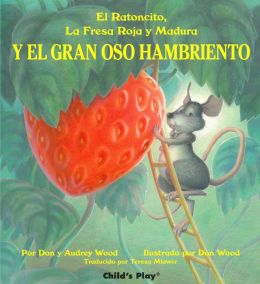


El Ratoncito, La Fresa Roja Y Madura y El Gran Oso Hambriento-A little mouse tries to save a strawberry from a hungry bear.

Here is a list of other resources and activities I will be doing with my students...


One of the activities we will be doing is playing a "Collect It" game. I made the above labels with the different parts of a plant to display during the game. I then made little cards with different types of fruits and veggies on them. {You can find the pictures here.} Here is how you play...Make sure you have made enough cards so that each student that is playing can collect each part of the plant. For example: Radishes are roots, peas are seeds, etc. The goal is for each student to end up with six items each one representing the six parts of a plant. You can make a few extra cards if you like. You start playing by laying all the cards face down. Each student takes a turn picking up a card. If they need that card they lay it face up in front of them. If it is a duplicate part then they return the card and lose their turn. The first to collect the six parts wins.  NOTE: Some of the veggies can be tricky. For example, did you know that potatoes are actually part of the stem? And onions are actually leaves not roots even though we call them root vegetables? So make sure you know what is what before playing with the kids.

Pumpkin Life Cycle War Card Game-Anytime I teach a life cycle {like the life cycle of a plant} I teach/review the ordinal numbers. This game is great for this! I know it is in English, but I will use it to review Spanish vocabulary. When kids lay down their cards they will have to say the stage in Spanish or the ordinal number in Spanish {depending on how we decide to play that round.}

Fold and Learn Plant Parts {in Spanish or English}

Plant Unit in Spanish

Roll and Build a Flower Game-To review the parts of a flower

Finally, here is a printable that I give to my parents on what their children are learning. It is the basic vocabulary for the unit.


Also, here is a file for the parts of a plant labels for the Collect It game...


Enjoy exploring plants with your students!