Showing posts with label Verbs. Show all posts

Thursday, November 2, 2017

Dice Sentences {Free Printables}


{Affiliate Links Used}

Want a quick and easy way to do some review in groups with verbs and the formation of sentences? All you need are these printables {see below} and some colored dice {These work well.}. Basically, students roll four dice at a time (red, green, blue, and orange) and depending on what numbers they get on each colored die they create sentences.  Here's an example:


Let's pretend that a student rolls the following: red 2, green 3, blue 4, and orange 6. The sentence he or she creates would be "Tú estudias español todos los días en la biblioteca." These sentences can be done in groups out loud as a class starter. They can also be written by students. Small groups of students (3 to 5) tend to work well for this activity. 

I have created four printables: 


You will notice with some of the charts the students create a sentence that conveys four pieces of information: who, what happens, when, where. Other charts have three pieces of information and then the type of sentence they are to create (affirmative, negative, interrogative). This adds another level to just straight sentences and makes them think about how to form different types of sentences.


So pull out some colored dice and get your students forming sentences!

Monday, April 24, 2017

Instant Lesson Plans for Your Language Classroom


{Affiliate Links Used.}

Let's face it. While teaching can be incredibly rewarding, it is also draining emotionally and physically (especially when you are sick). There are times when I really struggle to get through a teaching day. While I don't teach in a regular classroom (I give private and small group lessons), I still struggle from time to time to get through a lesson. Recently, I decided that I needed a master list of easy activities I could do with students when...
  • I'm not feeling well.
  • They have a make-up lesson.
  • We have a game day at the end of the semester.
I prefer not to waste precious time with my students with activities that don't further their language learning, and yet there are days when we need to step back and do something different. I was also realizing that coming up with ideas when I'm pressed for time or feeling ill wasn't working for me. I needed a ready-to-go list I could just pull out. So on a quiet afternoon, I did some brainstorming of all the activities my students have been exposed to that we could do on a game day or a day when I'm sick. (Or if you are teaching in a regular school...a day when you need a sub). I created a file and then printed out several copies to have on hand. I teach a big age range (age five through high school) and a myriad of ability levels. So it is easier for me to have a master list and circle the activities we are going to do based on the ages of the students and their abilities. It becomes my instant lesson plan.


If you are teaching larger groups, you may need to break students into groups and have "stations" where they move from activity to activity during the class. That way no one gets bored and all the teacher has to do is monitor the groups.


Here's some of what is on my list with links to see how it's all done. However, since every teacher is different it would be ideal for you to come up with your own list of activities that work in your classroom.


So pull out a piece of paper or open up a file and start brainstorming ideas for the days when teaching is tough!! I welcome any other ideas in the comments!!

Saturday, August 20, 2016

How to Wash a Woolly Mammoth {Book Activities for Spanish Learners}


{Affiliate Links used.}

There are just some children's books I read that are so endearing that I immediately have to share them with my students. Como Lavar a un Mamut Lanudo is one of those books, because don't we all need to know how to wash our woolly mammoths?! This precious book takes you step-by-step through the process. Fill a bathtub. Add bubbles. Add a mammoth. You get the picture. So here are a few activities you can do with your young Spanish students after reading this book...

Younger students can count the steps (There are ten of them.) mentioned in the adventure of mammoth washing. You can also have them count in Spanish the useful items (that can clean your mammoth) on the back cover. Another idea would be to count how many times the "pato" shows up in the story or count the leaves in the illustration of the messy mammoth at the beginning of the story. Here is a coloring page to go along with the book in which your students can count the bubbles.

With the story you can do a  review of body parts and the learning of a few new ones your students may not know like tusks, hooves, and wool. Teach and review the words and then call them out to see if they can find the parts one one of the pictures of the mammoth.

There are a ton of actions words in the story...have your students get out a piece of paper (after you have read the book to them) and call out one of the steps in cleaning a mammoth. Can they draw the steps that you call out? Along the same lines, can you call out two or three of the steps in Spanish and have your students tell you if they are in the correct order or not. The steps could also be written out on cards to see if your students who are reading Spanish can put them in order.

This book lends itself well to doing some bubble painting! Here are some simple instructions for this cool art activity. After the painting are done and dried, you can talk in Spanish about the bubbles represented in the art and work on noun/adjective agreement...


Burbujas moradas, burbuja grande, burbuja chiquita, burbujas verdes, etc.

Have fun learning all about giving woolly mammoths baths!

Monday, June 27, 2016

Se Venden Gorras

{Affiliate links used.}

Se Venden Gorras is a classic book that you can use to reinforce colors, actions, and prepositions in Spanish. Let's take a quick look at what you can do with this book when teaching Spanish...

A fun activity to do with this book is TPR (Total Physical Response). There are several actions within the story that you can ask your students to perform through giving commands in Spanish. Here is a list of the actions you can use...

Dormirse, despertarse, tocarse la cabeza, buscar a la derecha (a la izquierda), buscar a espaldas, levantar la vista, señalar con el dedo, apretar los puños, dar puntapiés, quitarse la gorra, tirarla al suelo, arrodillarse

With these actions, you can also play Simon says.


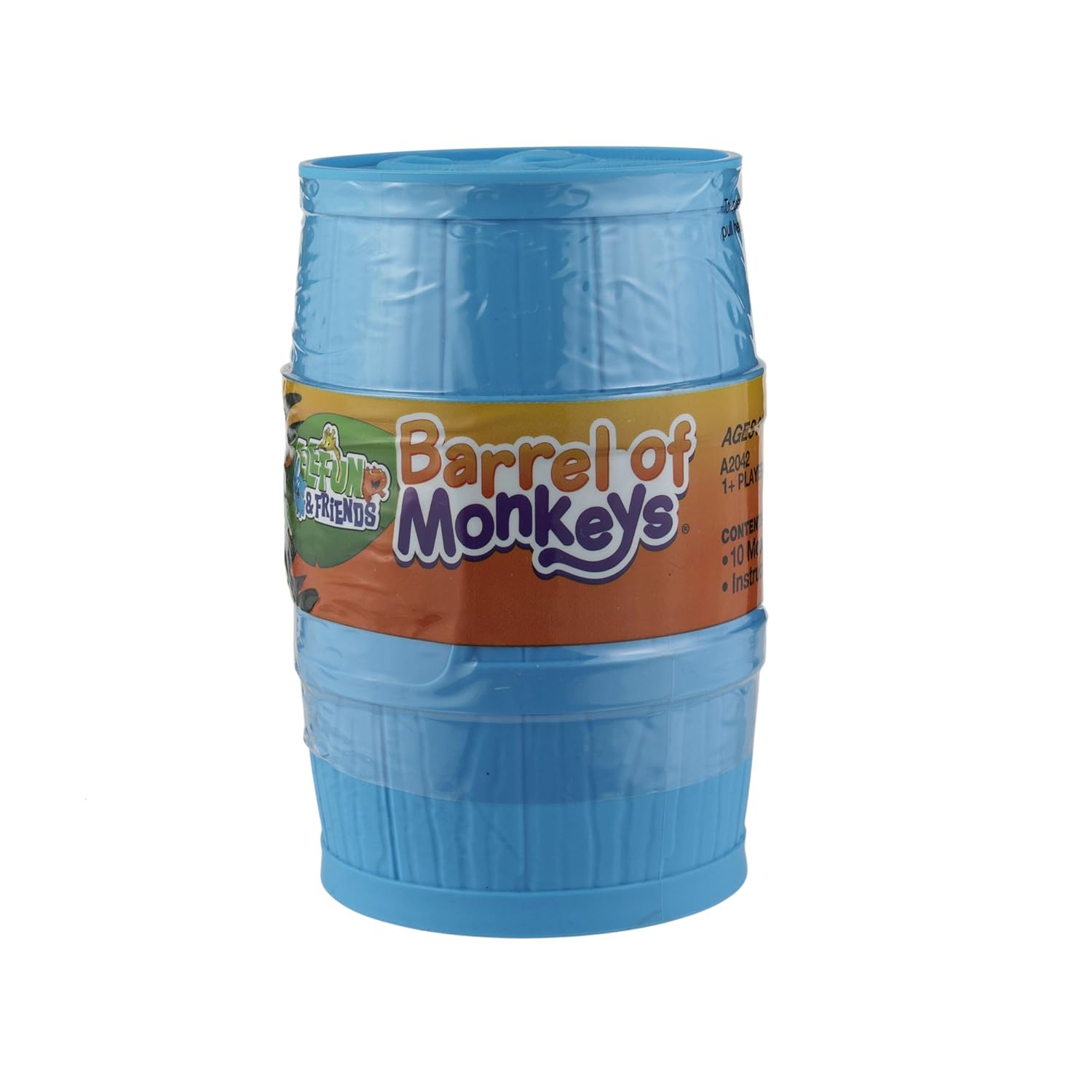
Remember the old game, Barrel of Monkeys? This would be a great time to play that game and practice counting in Spanish. 

This is a great printable you can do with your students. Give them instructions in Spanish on how many blue caps, red caps, etc. they need. Then also tell them in Spanish the order of the caps (you can make up a new order that's different from the book) that go on the peddler's head. Here are some more printables that are similar in which you can do a sequencing activity in Spanish.

Here are some free printables for the book. Yes, they are in English, but be creative and think of ways you could use them in Spanish. 

Here's such a cool idea...have your students recreate the story with actual manipulatives! This idea comes from Magical Movement Company. You can find it here.

CLICK HERE for more book activities.


Tuesday, April 19, 2016

Toys for Language Learning


Affiliate Links used.

For young kids (and even some older ones), there is incredible value in having items that they can manipulate as they learn. My students eyes light up when I bring out any type of item that is toy-like to help them acquire Spanish. That's why this list of building sets could be incredibly valuable when you are teaching another language to kids.

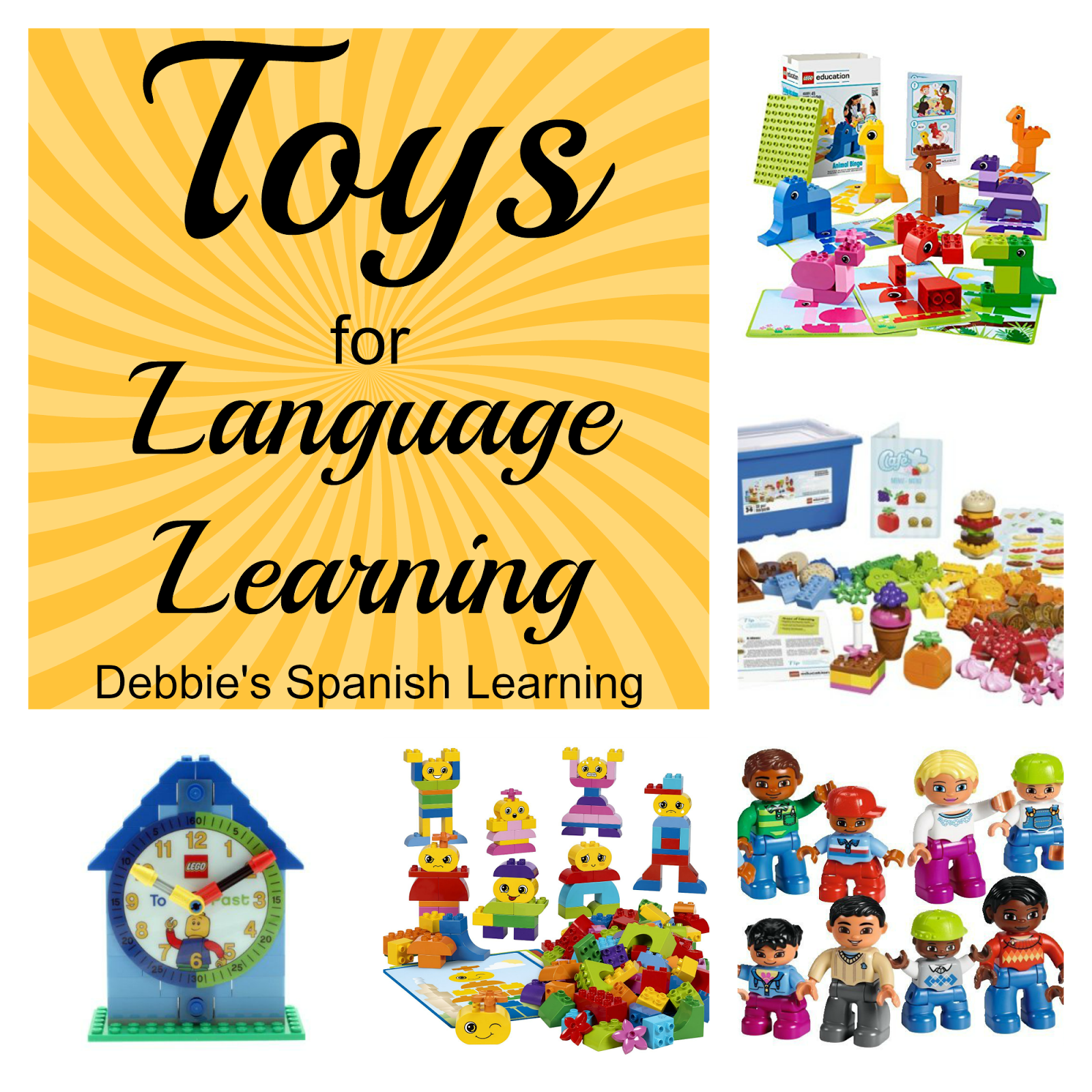
These LEGO® sets would work really well if you are teaching young kids a foreign language...

The first one that caught my eye was the Build Me Emotions set. For years I have struggled to come up with ideas for teaching emotions so I am always on the lookout for new ideas. I see so much potential for this set like...

  • Telling students "Edifica triste" or "Edifica contento" then having kids build a character with that emotion.
  • Calling out an action in the target language and having them make a person with an appropriate emotion on its face. For example, the teacher says "Yo como el chocolate" and a happy person is built.
  • Describing a person (what they are wearing) and what they are doing then having kids make that person with the correct colored clothing and a facial expression for the action.


The Animal Bingo set is a like a bingo game in which kids pick a building card that allows them to create an animal as they collect the pieces for it. With this game, there is the opportunity to learn animal names, colors, and shapes.


The World People Set are great props for physical description of people and clothing. The vocabulary for family members would work well with these also. I would use this set by displaying all the figures and then describing in Spanish one of the people to see if my students can guess who I am talking about. Students can also describe the people in the target language. Another idea is to categorize the people into groups by calling out a characteristic like "pelo moreno" or "lleva azul" and have your students separate out those that fit into that category.


Community Minifigures - a great set for discussing occupations and descriptions of people.


Time Teacher with Constructible Clock- A clock that kids can build and that you can use with them to teach them to tell time!


Family and House Kit- Build this house and then there are opportunities to talk about the rooms of the house and what they contain. This set would be great to work with prepositions. Students could describe where things are located in the target language or the teacher could tell students where to put certain items.


This Food Set has a plethora of pieces so that kids can "build" different foods. This is definitely on my wish list as I know my younger students would adore it! There are opportunities to discuss the colors of the foods, learn new food words, and even do categories of foods (like fruits, veggies, meats, etc.)

LEGO®is a trademark of the LEGO Group of companies which does not sponsor, authorize or endorse this site.


Sunday, January 24, 2016

Story Cubes {Fluency in Second Language Writing}

{Affiliate links used}

Yesterday I had a post about using Rory's Action Story Cubes  to practice with verbs in your language classroom. {See the post here.} Today I am going to show you a simple way to get your students writing creatively with these cubes. 

First of all, you will need this printable, Story Cube Writing. It is for Spanish students, but you could make a different one in you teach another language. Basically, I give a space for students to list the pictures they rolled on the dice. They are separated into categories: nouns, verbs, and adjectives. Then there is space for them to write a story.

Then you will need at least two sets of these cubes. One of the sets needs to be the Action One and then you can pick any of the others which contain mostly nouns and some adjectives.


There are several sets of Rory's Story Cubes, here's a list of all of them that you can choose from...

Rory's Story Cubes-The original set
Rory's Story Cubes Actions-The "verb" set
Rory's Story Cubes - Voyages- These are awesome! Pictures of a camera, cave, circus tent, mountains, and so much more!
Rory's Story Cubes Mix- Enchanted, Prehistoria, Clues-Pictures related to fairy tales, dinosaurs, and crime investigation.
Rory's Story Cubes - Original, Actions, Voyages, Prehistoria, Enchanted, Clues (Set of 6)- This includes all the sets!

Give your students the dice and have them roll all of them at once {the two sets}. Have them list on the printable in the target language at least five nouns and five verbs. Since there are not many adjectives tell them if they get one or two that will be fine. Their job then is to come up with a story using all the words they listed. NOTE: If you are doing this with a large group of students, break them down into groups. Have someone in the group roll all the dice once and then each student in the group writes down the words they want on their own paper from that one roll of the dice. This negates each student having to roll which takes time.

You should be able to read some pretty creative stories! I know I have!


Saturday, January 23, 2016

Story Cubes for Verb Conjugations


{Affiliate links used}

Anytime as a teacher you can give your students another fun way to practice what they are learning you have succeeded! I am constantly looking for other ways to help my students practice Spanish in unique ways. Verbs tend to be one of the hardest concepts to master in Spanish because there are so many forms. So I was delighted one day as I walked down the aisle of a local store to find Action Story Cubes! There are nine dice in the set each with a small picture of an action on each side so that's 54 different verbs! Here are some ways they can be used when teaching another language...

-Create cards that have the subject pronouns on them {I, you, he, she, etc.}. Place them face down on the table. Then have your students roll the dice {They can roll one or all of them.} and pick up one subject pronoun card. They then pick a verb {if they rolled more than one die} and conjugate that verb according to the subject pronoun card.

-For more advanced students, add another set of cards with the names of the tenses on them {present, past, future, conditional, etc.}. Now the students must conjugate verb according to the subject and the tense on the cards.

-For beginners, have the student roll all the dice and see how many actions they can name.

-Roll the action dice along with other Story Cubes. Have them create sentences using at least one action and one other cube. NOTE: Each set of cubes is in a different color which makes it easier to separate out the sets later and for your students to see which are the action cubes and which are the regular ones. 

All of the above activities can be used with small groups. If you teach a larger number of students you can break them down into groups of four or five. Because monitoring what students are doing in several groups is hard, I would sometimes have them write down their answers from what they did. Later you can go back and briefly check their papers to see if they were understanding. Writing what they came up with is particularly great if they are creating sentences. 


There are several sets of Rory's Story Cubes, here's a list of all of them that you can choose from...

Rory's Story Cubes-The original set
Rory's Story Cubes Actions
Rory's Story Cubes - Voyages- These are awesome! Pictures of a camera, cave, circus tent, mountains, and so much more!
Rory's Story Cubes Mix- Enchanted, Prehistoria, Clues-Pictures related to fairy tales, dinosaurs, and crime investigation.
Rory's Story Cubes - Original, Actions, Voyages, Prehistoria, Enchanted, Clues (Set of 6)- This includes all the sets!

Come back tomorrow and read about how I use these cubes to encourage my students to write in the target language. There will also be a free printable!!


Friday, January 22, 2016

Using Dice in Language Teaching

{Affiliate links used.}

{NOTE: This is a re-post with added information and ideas.}

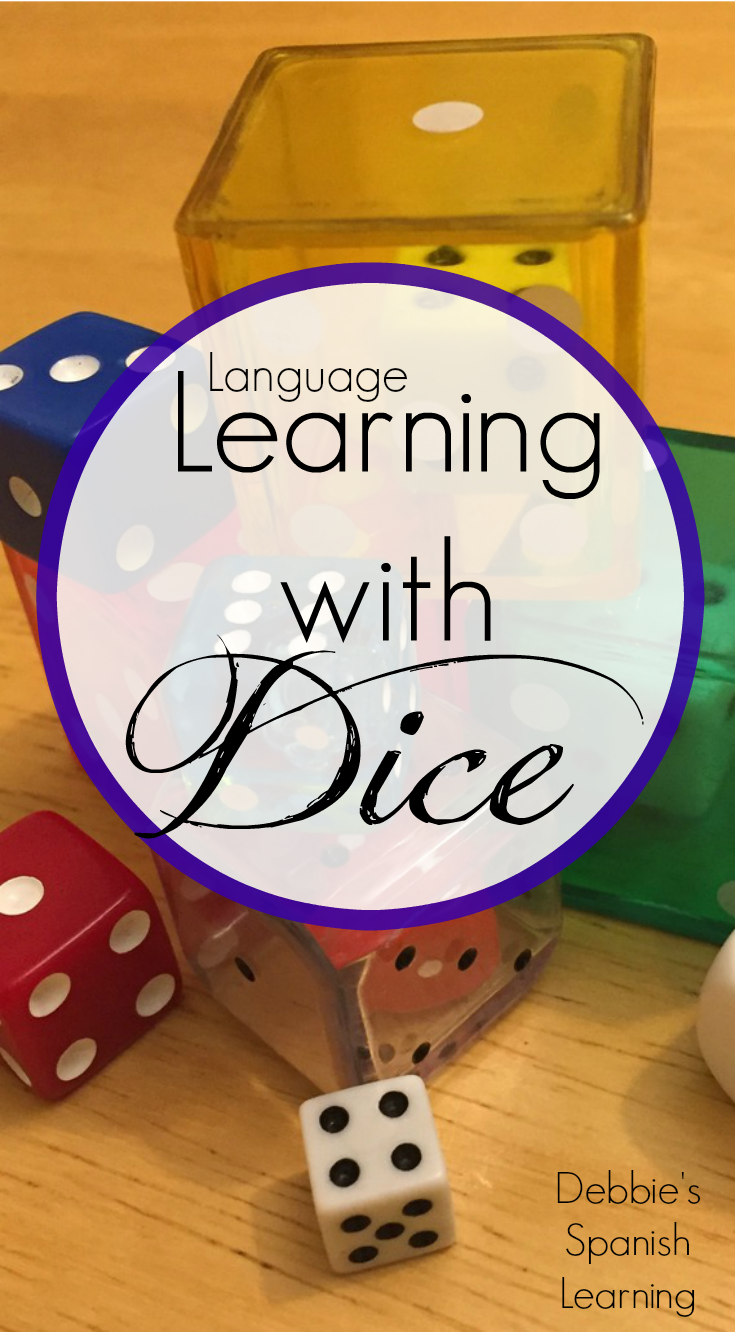
I love making language learning into a game if possible. Even if the activity we are doing isn't really a game, dice give a hands-on experience to what we are practicing in the language.  There are several types of dice that I use when teaching.


Dice Within Dice are great for practicing sentence constructions, verb conjugations, and adjective/noun agreement.  On my whiteboard I will normally make two lists.

COLOR
1. Uds.
2. yo
3. Carla y yo
4. ella
5. tu
6. Ud.

BLANCO
1. decir la verdad
2. hacer la tarea
3. pedir la comida
4. encontrar un gato en la calle
5. salir con amigos
6. perder los libros

Students takes turns rolling their "Die within a Die" and creating a sentence.  For example, if a student rolled a "2" for the colored die and a "4" for the white die, the sentence she would need to come up with would be "Yo encuentro un gato en la calle."

One way to mix this activity up a bit is for the teacher to participate.  I roll the dice and then say the sentence, but I don't always do it correctly.  It is the students' job to figure out if the sentence is "correcto" or "incorrecto".

This method could be done with lots of types of sentences.  Here are some ideas:

-Subjects and adjectives {Ella es flaca.}  Great for practicing noun/adjective agreement.

-Subjects and items we know.  {Ella sabe bailar.   or  Yo conozco a la profesora.}  This is great for practicing the difference between saber and conocer.

-Subjects and adjectives-some that take ser and other estar.  {Nosotros estamos aburridos.   or  Uds. son altos.}

-Even more complex sentences can be done if you give the students three dice (or one die within a die and a single separate die).  For example...
Subjects-objects-recipients of the objects {Yo le doy la bici a Ricardo.}  Or use double object pronouns...{Yo se la doy.}

-Also with three dice:  Subject-preposition-place  {Yo estoy a la derecha de la silla.}

-With four dice or two dice within dice...
subject-verb that takes subjunctive-subject-second verb  {Yo quiero que Carlos haga la cama.}

-Or how about practicing different verb tenses? Use three regular dice...Subject-verb-tense to see if your students can conjugate into the correct mood or tense.

NOTE: Sometimes when working with big groups of students I break them down into groups of four and have them write down the sentences they create to have a record of what they did in their groups.


Blank White Dice hold a plethora of possibilities!! You could write subject pronouns on them to work with sentence building. Or maybe you want to write the names of tenses on them to use. Another idea is to write the infinitives of verbs especially the irregular ones that need tons of practice.


Number Dice are great for practicing saying the numbers out of order.  It is great when a student can learn to count in Spanish or another language, but the true test is when they can see the number and tell you what it is.  Sure, students for awhile might have to "count up" to tell you the number, but the more they practice the easier it gets.  I use one to four of these dice and have them roll them all at once. Then they have to line them up and tell me what number they have. Great for older students needing to practice higher numbers like 4,350 or 1,642.

Another option is to have a group of number dice on the table and then call out a number that the student then has to create with the dice.


Math Operation Dice along with regular dice can be used to do math problems in the target language.