Showing posts with label Telling Time. Show all posts

Tuesday, April 19, 2016

Toys for Language Learning


Affiliate Links used.

For young kids (and even some older ones), there is incredible value in having items that they can manipulate as they learn. My students eyes light up when I bring out any type of item that is toy-like to help them acquire Spanish. That's why this list of building sets could be incredibly valuable when you are teaching another language to kids.

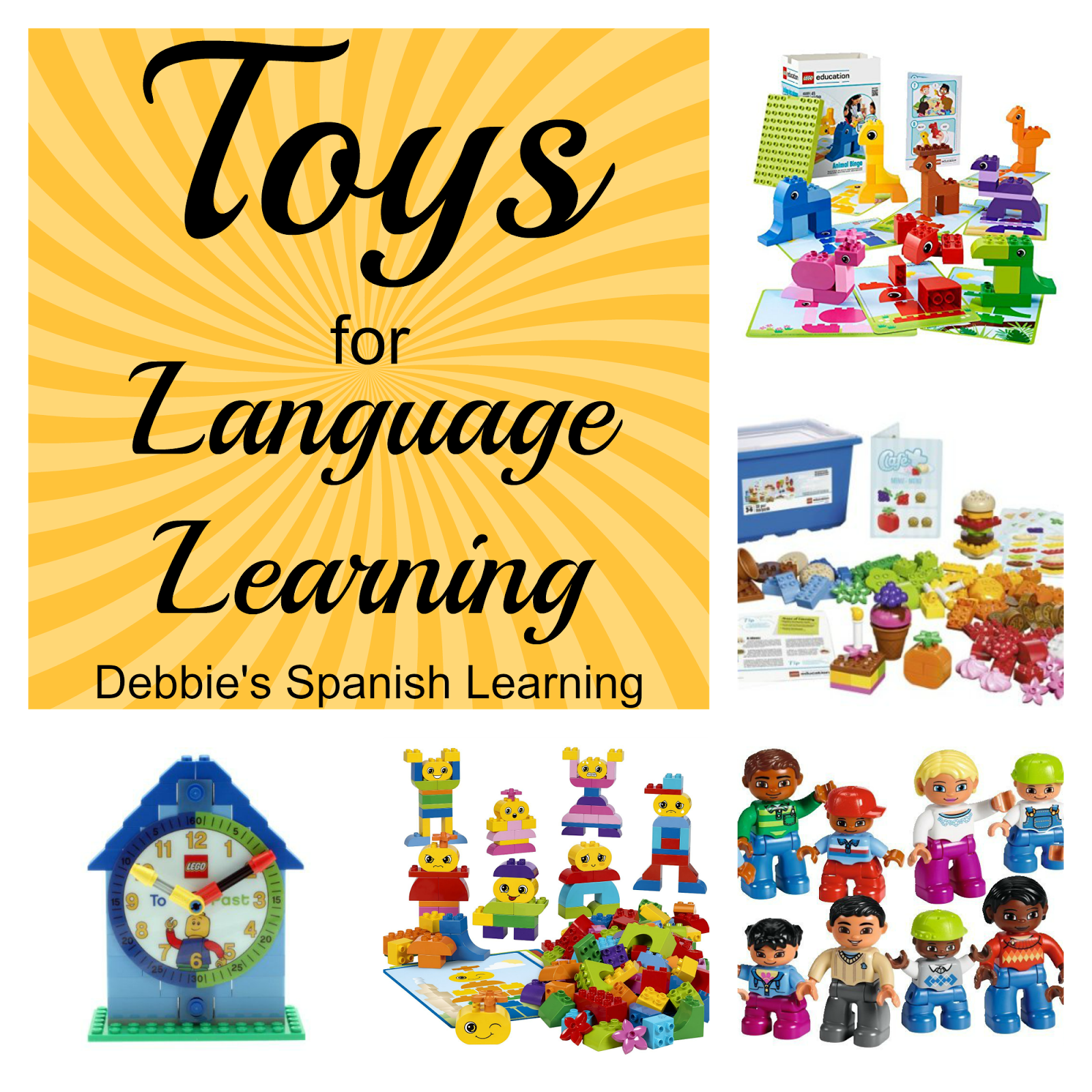
These LEGO® sets would work really well if you are teaching young kids a foreign language...

The first one that caught my eye was the Build Me Emotions set. For years I have struggled to come up with ideas for teaching emotions so I am always on the lookout for new ideas. I see so much potential for this set like...

  • Telling students "Edifica triste" or "Edifica contento" then having kids build a character with that emotion.
  • Calling out an action in the target language and having them make a person with an appropriate emotion on its face. For example, the teacher says "Yo como el chocolate" and a happy person is built.
  • Describing a person (what they are wearing) and what they are doing then having kids make that person with the correct colored clothing and a facial expression for the action.


The Animal Bingo set is a like a bingo game in which kids pick a building card that allows them to create an animal as they collect the pieces for it. With this game, there is the opportunity to learn animal names, colors, and shapes.


The World People Set are great props for physical description of people and clothing. The vocabulary for family members would work well with these also. I would use this set by displaying all the figures and then describing in Spanish one of the people to see if my students can guess who I am talking about. Students can also describe the people in the target language. Another idea is to categorize the people into groups by calling out a characteristic like "pelo moreno" or "lleva azul" and have your students separate out those that fit into that category.


Community Minifigures - a great set for discussing occupations and descriptions of people.


Time Teacher with Constructible Clock- A clock that kids can build and that you can use with them to teach them to tell time!


Family and House Kit- Build this house and then there are opportunities to talk about the rooms of the house and what they contain. This set would be great to work with prepositions. Students could describe where things are located in the target language or the teacher could tell students where to put certain items.


This Food Set has a plethora of pieces so that kids can "build" different foods. This is definitely on my wish list as I know my younger students would adore it! There are opportunities to discuss the colors of the foods, learn new food words, and even do categories of foods (like fruits, veggies, meats, etc.)

LEGO®is a trademark of the LEGO Group of companies which does not sponsor, authorize or endorse this site.


Tuesday, January 12, 2016

Teaching Concepts of Time

{Affiliate links used.}

I have found that teaching concepts of time can be challenging especially for younger kids. So here is a look at some ideas you can use to teach time, months, days of the week, and seasons.

A Teaching Clock is a great item to use as you explain telling time in a target language. I love this site to print out blank clocks (I white out the times underneath) to use in a listening activity. I call out a time in Spanish and they draw the hands on the clock. The site also offers clocks with hands already on them. These can be homework sheets in which students write out the time in the target language. This printable available over at Teachers pay Teachers is a great way to display time if you teach Spanish.

The months are pretty easy in Spanish as they mostly sound or are spelled like the English words. A real easy game to do with the months is to make flashcards for each month. Make a set for each student you have. I add in a few extra cards with a silver dot {see above} on them as "freebies". Lay all the cards face down on the table. NOTE: You will need a full set of year cards for each student. Students take turns picking up on card and saying the month in the target language. The trick is they must collect the months in order. So unless they have picked up January or a silver dot they must put the card back. After they have January the next goal is February and so forth. The game will start out slow, but as more cards are kept it gets easier. Normally, this game goes well if students are in small groups of no more than five.

For teaching the seasons, please check out this post of mine. It contains book suggestions for younger kids, a link to a homework sheet, and tips on helping students remember the names of the seasons.

For the days of the week I have two posts. This post is for younger kids using a famous children's book to review the days. Here is another post to use with older students or ones that have learned to read. This game is almost identical to the months game I just described above.

I also have a free printable on my site that reviews dates, seasons, and weather. You can find it here.

There are very few children's books out there that deal with concepts of time, but these are great to use if you are working with younger kids in Spanish...


Un recorrido por las estaciones incorporates the seasons, months and days of the week. I love the reference pages in the back that show the origin of the the names of the days of the week. {Did you know that many of the days of the week in Spanish refer to planets in our solar system?} It also describes the origin of the names of the months.

Chumba la Cachumba is wonderful for teaching the top of the hour to young kids. Here is my review of the book.

La oruga muy hambrienta- A classic that covers the days of the week.


Tuesday, January 5, 2016

Using Stickers in Language Learning


{Affiliate links used.}

Kids love stickers! One of the ways I add variety to my teaching is to occasionally pull out my collection of stickers and use them in listening activities with my students. The basic idea is for each child to have the same set of stickers to use on a piece of paper with a picture or various pictures on it. I describe the sticker in the target language and where to put it on the page. I then see if my students can follow directions.

For the pages we use I love these books, Basic Vocabulary Builder and Practical Vocabulary Builder. They are blackline master with thematic pictures on each page. Here are some examples...


I have also used other types of pages like when we learn how to tell time in Spanish I use a sheet filled with pictures of clocks. I instruct my students to put a certain sticker on the time I tell them. A final idea on pages? You can use any scene with lots of items and actions in it. The more there is on the page the more the students have to listen carefully to your instructions and hunt for the correct picture to put their stickers on.

Here are sheets of stickers I have found useful. The goal is to use sheets that have enough items that are different from each other that you can describe to your students exactly which sticker to use.


Monsters Shape Stickers  are great because you can review colors, body parts, and even a few animal words (For example, one of the monsters has the nose of an elephant. Another looks like a snake.)

Penguin Stickers- Great for reviewing winter clothing like hats, scarves, skis, etc. See this post for another activity with these stickers.

Emoticons Stickers-Use these to review emotion vocabulary.

Snowmen Stickers -Once again for winter clothing.


Robot Stickers- Also great for reviewing body parts

Pirate Stickers- Lots of vocabulary here!

Kid Stickers-These are awesome for reviewing how to describe people.


Alphabet Stickers-I use these after teaching the alphabet.


Friday, January 30, 2015

María Tenía una Llamita


This post is part of a series, 31 Days of Spanish Books for Kids. Please click HERE for the complete list of posts. {Each of these posts contain affiliate links. Thanks for supporting this blog!}


We are all familiar in the United States with the song "Mary had a Little Lamb". But how about María Tenía Una Llamita? Set in Peru, the text follows the original rhyme (It is printed in both English and Spanish) except it is no longer a lamb and María is dressed in the traditional clothing of the area.

While this book is simple in its language, I find it invaluable for introducing to the youngest of children the concept of different cultures. Even the fact that there is a llama instead of a lamb throws some kids into confusion as there are many young children that have no experience with what a llama is. So we spend some time talking about this "new" animal.  I also point out other visible cultural differences like the clothing of the teacher and students, the open-air market, and the traditional musical instruments. This book also provides an opportunity to take a look at geography.  There is a simple map in the book that labels a few places in Peru. There is also a page with several clocks that show the passage of time in the story, and you could introduce the "top of the hour" and how to say it in Spanish.

This is one of my favorite books for introducing younger kids to South America and is not to be missed!

Friday, January 2, 2015

Chumba La Cachumba


This post is part of a series, 31 Days of Spanish Books for Kids. Please click HERE for the complete list of posts. {Each of these posts contain affiliate links. Thanks for supporting this blog!}


Chumba la Cachumba is a cute book that uses a traditional Hispanic song about a group of skeletons and their activities each hour of the day. It is a great book to use with elementary kids that are learning to tell time because the humorous illustrations, rhymes, and rhythm make the book one that students want read to them again and again. This is also a book that students can participate in as you read to them. The "Chumba La Cachumba La Cachumbamba" is repeated at the end of each page and is easy for students to recite.


Many times I use Chumba to introduce the concept of time and teach the top of the hour. As I read I will sometimes let a student be in charge of a teaching clock and they have to create the time that is displayed on the page with the clock. The book can also be used to exploring rhyming in Spanish as each number on the clock has a rhyming word to go with it. {See my post on teaching rhyming words.} 

The other marvelous aspect of this book is the illustrations. While the subject matter could be considered macabre, the pictures are so funny that students seem to overlook the graveyard and skeletons.  There are a plethora of culture references (Hispanic and non-Hispanic) throughout.  Here are some examples of cultural items that show up...

Hamlet
George Washington crossing the Delaware
Running of the bulls
Bullfighting
Mona Lisa

La Chumba is a book not to be missed!