Showing posts with label Emotions. Show all posts

Wednesday, May 4, 2016

Teaching Emotions in Spanish

{Affiliate links used.}


Emotions can be tough vocabulary to teach, because of the lack of activities to go with the subject matter. Over the years I have slowly added ideas to my repertoire for teaching feelings. Here is a collection of ideas for you to use.


I recently bought these cards. My students are intrigued by the faces and find them funny. I had my husband at one point draw these faces onto ping pong balls. You can see my post about them here. I use these cards and the ping pong balls to talk about feelings in the target language. For example, with the ping pong balls I will put them in a bag. Each student picks one out and tells me how he or she is feeling according to the face on the ball. With the cards, you can print out labels with emotion vocabulary words on them and have the students match the word with the picture card as a review activity at the beginning of class.


 I do like the cards as they are larger than regular playing cards. I will, however, say that there are several cards in the deck that give the words for all the feelings in different languages. So for example, there is a card with all the faces from the deck with the Spanish words for those emotions underneath them. There are similar cards for French, German, Polish, etc. There are 25 of these language cards which may not be useful to you except for the one language you are teaching. I still feel that  they are worth it for me to have as visual aids. I believe there are thirty emotions cards (just with one face on it) total. So if this makes sense: 30 emotion cards (see the first two pictures in this post), 25 language cards (see the third picture) for a total of 56 cards.


Así Me Siento Yo is by far the BEST emotion book out there for kids. {And please, if you come across another, let me know!} The illustrations are beautiful and clearly depict the emotion even if kids are still learning the vocabulary. Here are two posts with feelings activities that you can do with your students after reading the book. This first one is great during the fall, and the other would be a great spring activity. There are free printables on each post.


If you are working with younger kids this set of bricks would work well when introducing feelings.

Another activity I do with my students involves these stick figures from Spanish Playground. You will notice that the printable has descriptions under each figure, but sometimes I turn this into a listening activity for my kids. I will describe what the person is wearing, how they are feeling, and even the weather (which kids normally draw above the figure...like a sun for example or clouds). The students then must draw all the items in. It's a great way to review lots of different vocabulary!

And finally, if you have students who can read try the Caramba game. It can review all many different sets of vocabulary including emotions. Lots of fun!

Tuesday, April 19, 2016

Toys for Language Learning


Affiliate Links used.

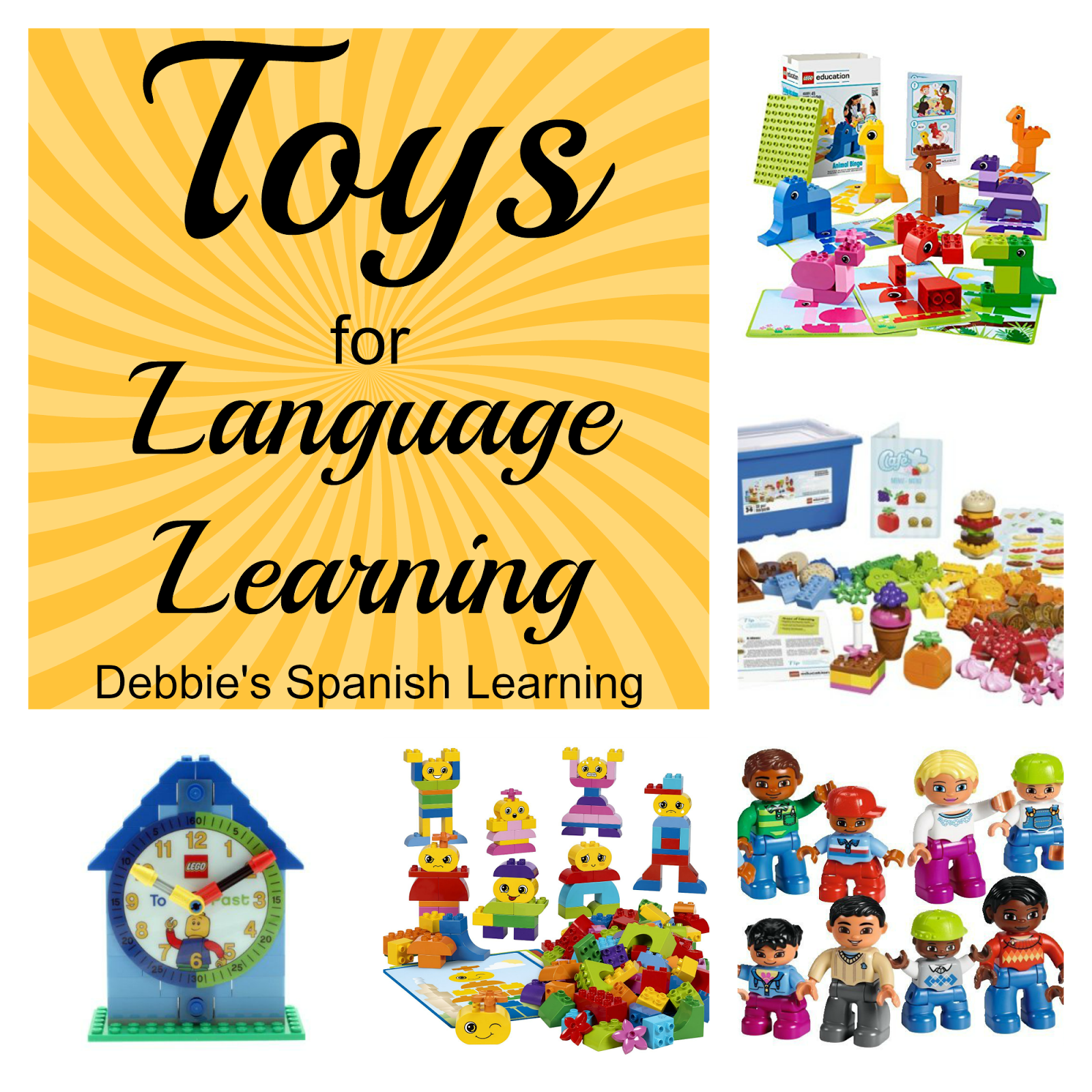
For young kids (and even some older ones), there is incredible value in having items that they can manipulate as they learn. My students eyes light up when I bring out any type of item that is toy-like to help them acquire Spanish. That's why this list of building sets could be incredibly valuable when you are teaching another language to kids.

These LEGO® sets would work really well if you are teaching young kids a foreign language...

The first one that caught my eye was the Build Me Emotions set. For years I have struggled to come up with ideas for teaching emotions so I am always on the lookout for new ideas. I see so much potential for this set like...

  • Telling students "Edifica triste" or "Edifica contento" then having kids build a character with that emotion.
  • Calling out an action in the target language and having them make a person with an appropriate emotion on its face. For example, the teacher says "Yo como el chocolate" and a happy person is built.
  • Describing a person (what they are wearing) and what they are doing then having kids make that person with the correct colored clothing and a facial expression for the action.


The Animal Bingo set is a like a bingo game in which kids pick a building card that allows them to create an animal as they collect the pieces for it. With this game, there is the opportunity to learn animal names, colors, and shapes.


The World People Set are great props for physical description of people and clothing. The vocabulary for family members would work well with these also. I would use this set by displaying all the figures and then describing in Spanish one of the people to see if my students can guess who I am talking about. Students can also describe the people in the target language. Another idea is to categorize the people into groups by calling out a characteristic like "pelo moreno" or "lleva azul" and have your students separate out those that fit into that category.


Community Minifigures - a great set for discussing occupations and descriptions of people.


Time Teacher with Constructible Clock- A clock that kids can build and that you can use with them to teach them to tell time!


Family and House Kit- Build this house and then there are opportunities to talk about the rooms of the house and what they contain. This set would be great to work with prepositions. Students could describe where things are located in the target language or the teacher could tell students where to put certain items.


This Food Set has a plethora of pieces so that kids can "build" different foods. This is definitely on my wish list as I know my younger students would adore it! There are opportunities to discuss the colors of the foods, learn new food words, and even do categories of foods (like fruits, veggies, meats, etc.)

LEGO®is a trademark of the LEGO Group of companies which does not sponsor, authorize or endorse this site.


Thursday, April 7, 2016

¡Caramba! Game

{Affiliate links used.}

I am closing out the school year with my Spanish lessons and wanted a way to review the vocabulary we have been working on. I came across on Pinterest a post about Kaboom! It was created for elementary classrooms, but I thought it would be perfect for language learners also! So here is how you go about it:

First of all you will need...

Jumbo Craft Sticks
Sharpie Markers
Cups (Not see through)

Since I work with a lot of different levels of students I had several categories of vocabulary I wanted to use like house items, the alphabet, clothes, opposites, etc. I decided to color-code the sticks  on one end. This helps with two things. Kids will know how to put them in the cup with the colored part sticking out. This allows me to  select which sets of vocabulary to use with certain sets of students. For example, I know that the orange sticks are emotions and the pink sticks are foods. {See the final set of pictures for the list I made for myself.}


After you color the tips, you write one word towards the other end of the stick. I tend to use about 15 sticks for a vocabulary-themed set. Three of those sticks will have the word "Caramba" written on them. The rest will have vocabulary words you want kids to review.


To play the game you put one set (or maybe two or three if you have more advanced students) in a cup with the colored tips up. Students take turns pulling a stick out of the cup and giving the translation of the word. They keep the stick if they can say what it means in English. Otherwise, they put it back in the cup if they don't know. If they pull a "Caramba" stick they have to put back ALL their sticks! I time the game for about three minutes. The student with the most sticks at the end wins!

This is a fun way to review vocabulary which at times can be tedious!


Tuesday, March 1, 2016

Easter Resources {Spanish for Kids}

{Affiliate links used.}

Easter comes early this year at the end of March. So here is a look at resources that are available if you teach Spanish to kids.

First of all, I have a post filled with books related to spring. You can find it here.  Look through the list of books to find ones that might work around Easter time.

Here are some books that are more specific to Easter.


LA Sorpresa De Mama Coneja- This sweet book is about some little bunnies who decide to surprise their mom with eggs from different birds.


The Legend of the Cascaron- A bilingual book on how the tradition of "cascarones" came to be.


Easter is a great time to review emotions and to use eggs as the base for "emotional faces". My absolute favorite book about emotions is Así me siento yo . In the fall, we read this book and do pumpkin faces. During Easter, you can do the same thing but with eggs. {See this free printable.} We read the story and then each student gets an faceless egg page. I call out things like, "El huevo contento" or "El huevo triste", and my students draw the faces. Because this printable has color to it you can make it more difficult by saying, for example, El huevo anaranjado está nervioso.

Here are some fun eggs that can be used in your lesson on emotions. Read this post for teaching ideas.


Emoji Easter Eggs

Goofy Easter Eggs


Egg Face Stickers- You can go to this post to get ideas on how to use stickers in language learning.


Wednesday, October 22, 2014

Teaching Emotions in Spanish {Free Printable}


{Affiliate links used. Thanks for supporting this blog!}

Over the past few weeks I have been teaching a pumpkin unit to my students. One of the activities that I stumbled upon as we worked through the material is to teach emotions.  Having blank pumpkins to put faces on just naturally works with reviewing the vocabulary for different feelings.

By far, the BEST Spanish children's book that I have encountered to deal with a variety of emotion vocabulary is Así Me Siento Yo. (You can read my review here.) Not only does this book incorporate rhyming words, the illustrations really drive home what emotion is being talked about on each page. 

First, I read the book to my students. We then use the following printable. I call out the type of pumpkin (for example: la calabaza triste, la calabaza enojada) and they have to draw the appropriate face on one of the pumpkins on the page. It is amazing to see the creativity in my students...for example, I had a few students not draw a face on their "shy pumpkin" because in their view a shy person tends to turn away from others and you can't see his or her face. Brilliant!

This short lesson has really helped to cement some of the vocabulary on emotions that I have been struggling to teach to my students. Fall would be a great time to review once again feelings with your students! After all, every pumpkin needs a face filled with emotion.

Pumpkin Faces Printable


If you work with young kids this set from Lego Education looks awesome!

Tuesday, September 16, 2014

Great Book on Emotions in Spanish


{Affiliate links used. Thanks for supporting this blog.}

There are very few books out there in Spanish that I have run across that focus on emotions, but recently I found Así me siento yo , which presents several emotions in a great format! The book has a rhyme for each of the emotions covered. Each rhyme describes a situation that elicits an emotional response. I love the artwork in this book as the colors and scenes really portray the emotions that are being talked about. Even when my students don't know the Spanish word many times they can guess the feeling by looking at the illustrations.


Besides the very familiar emotions of happiness and sadness the book covers the following: tonto, asustado, resentido, enojado, agradecido, frustrado, timido, aburrido, emocionado, celoso, and orgulloso.


I will be using this book to introduce emotions and to teach the verbs "estar" and "sentirse". For more ideas on teaching emotions, see this post on teaching emotions with ping pong balls.

Also, this set from Lego Education looks amazing. What an awesome way to work with young kids and introduce them to feelings vocabulary!


Wednesday, September 10, 2014

El Increíble Niño Comelibros


{Affiliate links used. Thanks for supporting this blog.}

If you have read my blog for any amount of time you know that I love Oliver Jeffers' books in Spanish. Here are all my posts on the books I have used in my classes that are written and illustrated by him. El increíble niño comelibros is a cute book about a boy who loves eating books and becomes smarter with each book he consumes. The story line promotes reading and is great for delving into different categories of Spanish vocabulary and exploring some grammar points.


Here are some categories of vocabulary and grammar that you can touch on after reading the book:

Comelibros- A compound word.  See my posts on teaching compound words.

Types of Books- novelas, diccionarios, almanaques, libros de bromas, libros de historias, etc.

Verbs like gustar and encantar

Comparatives and Superlatives- Since the boy becomes smarter the more he eats and then is deemed the smartest person in the world you can discuss how to form comparatives and superlatives. There are the "mal", "peor", "bueno", "mejor" so you can talk about irregular comparatives. 


Preterite and Imperfect- The book is written in the past tense and gives great examples of how the preterite and imperfect work together in Spanish.

Emotions and Conditions- The book has the following words: enfermo, verde (for being sick), vergüenza, triste, complicada

Words related to digestion- comer, atiborrarse, devorar, la boca, la barriga, morder, masticar, tragar, la digestion


El Increíble Niño Comelibros is not to be missed!

Tuesday, January 14, 2014

Teaching Emotions with Ping Pong Balls


{Affiliate Links Used}

So here is a quick hands-on idea for teaching and reviewing emotions.  Get some Ping Pong Balls and a black sharpie.  Look online for facial expressions like these (See these cards) or come up with your own faces.


There are a plethora of examples when you google "How are you feeling today faces".  Then using someone who has artistic talent {Which would NOT be me.  My husband made the ping pong balls you see at the top of the post.}, draw a face on each ball.

I use these ping pong balls to review emotions by putting all of them in a sack or bag.  One student asks another...
¿Cómo estás?  The second student pulls out a ping pong ball from the bag and answers according to what they see on the ball. He or she can then toss the ball into a bowl.  You continue doing this until the emotions run out.

Another game {a little more wild} is to place the balls in the center of a circle of students.  Call out an emotion and see who can retrieve the correct one first.  Note: Set some serious parameters on how to play so that no one gets hurt!!

Anytime you can add variety to your teaching...like with these ping pong balls, you increase the motivation to learn! Have fun!

Here are a few children's books in Spanish to go along with teaching emotions...

Quiero Mas Fideos!
¿Cómo me siento?- Very simple board book
Así me siento yo


And look at this great set for young kids...Lego Education Build Me Emotions.